

I have a lot of patients who never respond to Wegovy, the one we use mostly in Denmark.
It was the same for me, Wegovy gave me nothing.
It was the same for me, Wegovy gave me nothing.


The article itself opens with an example of a person that has been on Zepbound for 15 months and and may have lost a pound or two at most. Forty-Seven jumps right over that in a quest to call the contents of the article "lazy science." New York Times has a liberal bias to be sure, but that is way different than "lazy science." Everything in the New York Times is cross-checked. I take NY Times and find its science articles to be solid. I for one have been a low-responder. I got diarhea when I jumped up to approximately 5 mg sub per week. I had to drop down to a lower dose to prevent this effect, 2mg split into two subs weekly. I have gradually been working up again at the rate of 0.5 mg every four weeks. Didn't lose any weight at all for about five months. I got really sick and evidently between my sickness and tirz, I suddenly lost 4-5 pounds. There are most likely two ends to the stick. On one end, are the people who are extremely responsive, .i.e. I know of someone who takes 2.5 mg of tirz every 3-4 weeks to maintain his weight and the other end of the stick where some people are non-responsive. Some of the previous replies were from folks who had little to no reponse. Evidently, the writer is/was to busy writing to read those other responses.FortySeven said:More accurately, one in ten people who were accepted for a clinical trial were deemed "non-responders" -- which didn't even mean zero response, just less response. This is not the same thing as what the catchy subhead claims: 'But one in 10 people are what scientists call “non-responders.”' That suggests that 1 in 10 people in the population of the world are what they would call "non-responders".
This kind of lazy science reporting perpetuates false claims, but I guess it sells papers.
If you think about it, people who were accepted for the clinical trial are not necessarily "average" folks. They had to meet a bunch of qualifications, assumedly. And those qualifications mean that the clinical trial population probably had a higher percentage than the general population of people who were a) obese and b) had tried to lose weight in other ways/maybe with other meds and had failed. (I do not mean to use the word 'failed' as a judgment, btw.)
Anyhow, it's an interesting article, and it links to some other interesting articles (like the one about retatrutide clinical study participants dropping out because the were losing "too much" weight). I just get really annoyed by science reporting that makes to easy-breezy statements without much apparent critical thinking.

sfkid said:https://share.google/jTyQpIy8C6fxuSXq5
Based on this article it seems 1 of 10 people don't respond the GLP1s at all.
Does anyone know someone that has had zero response?
 It’s easy to get off by a decimal point, but it could be they were indeed a low-responder.
I didn’t say “lazy science”, I said, “lazy science reporting.” Two verrrrrrrry different things. All I was pointing out is that one in 10 people in a scientific study population is not the same thing as one in 10 people in the general population. That’s it. It’s a subtle issue of semantics, but it’s the sort of misinformation that gets perpetuated. I don’t think you even read my response closely enough to understand what I was saying, which is not questioning the validity of the study—nor its results—but rather questioning the translation of the study’s findings into the subheading of the article.dickybob said:The article itself opens with an example of a person that has been on Zepbound for 15 months and and may have lost a pound or two at most. Forty-Seven jumps right over that in a quest to call the contents of the article "lazy science." New York Times has a liberal bias to be sure, but that is way different than "lazy science." Everything in the New York Times is cross-checked. I take NY Times and find its science articles to be solid. I for one have been a low-responder. I got diarhea when I jumped up to approximately 5 mg sub per week. I had to drop down to a lower dose to prevent this effect, 2mg split into two subs weekly. I have gradually been working up again at the rate of 0.5 mg every four weeks. Didn't lose any weight at all for about five months. I got really sick and evidently between my sickness and tirz, I suddenly lost 4-5 pounds. There are most likely two ends to the stick. On one end, are the people who are extremely responsive, .i.e. I know of someone who takes 2.5 mg of tirz every 3-4 weeks to maintain his weight and the other end of the stick where some people are non-responsive. Some of the previous replies were from folks who had little to no reponse. Evidently, the writer is/was to busy writing to read those other responses.


FortySeven said:I didn’t say “lazy science”, I said, “lazy science reporting.” Two verrrrrrrry different things. All I was pointing out is that one in 10 people in a scientific study population is not the same thing as one in 10 people in the general population. That’s it. It’s a subtle issue of semantics, but it’s the sort of misinformation that gets perpetuated. I don’t think you even read my response closely enough to understand what I was saying, which is not questioning the validity of the study—nor its results—but rather questioning the translation of the study’s findings into the subheading of the article.
1:10 clinical trial participants does not equal 1:10 people. It’s not my opinion—it’s statistics.
I am a NYT subscriber. Their reporting is generally exceptional.
I didn’t jump over anything, and I’m certainly not on any sort of quest. I am, however, a critical thinker, and I encourage others to be as well.

I'll disagree with you on NYT being exceptional at anything other than narrow framing and strawmanning complex discussions, while remaining remarkably smug. At the same time, I agree with everything else you said and I'm glad to see someone else here honing in on the dishonest manipulations pharma regularly engaged in by shaping their study groups in clever ways to game drug approval and results.FortySeven said:I didn’t say “lazy science”, I said, “lazy science reporting.” Two verrrrrrrry different things. All I was pointing out is that one in 10 people in a scientific study population is not the same thing as one in 10 people in the general population. That’s it. It’s a subtle issue of semantics, but it’s the sort of misinformation that gets perpetuated. I don’t think you even read my response closely enough to understand what I was saying, which is not questioning the validity of the study—nor its results—but rather questioning the translation of the study’s findings into the subheading of the article.
1:10 clinical trial participants does not equal 1:10 people. It’s not my opinion—it’s statistics.
I am a NYT subscriber. Their reporting is generally exceptional.
I didn’t jump over anything, and I’m certainly not on any sort of quest. I am, however, a critical thinker, and I encourage others to be as well.


So.... It is 90% success rate.... That seems pretty high....sfkid said:https://share.google/jTyQpIy8C6fxuSXq5
Based on this article it seems 1 of 10 people don't respond the GLP1s at all.
Does anyone know someone that has had zero response?

A little late to the party but here is an archived copy of the NYT article.DjJoshua said:Maybe it's just me but that link wants me to create a account to read the article. Is there a different link?
Rolltide61 said:Reta does not work for me. Went as high as 10mg. Nothing on Tirz. Used Cagri w/ Reta and still zero hunger suppression.
Now check this out. Went on Melanotan ll. Zero hunger.
Ain't that something.
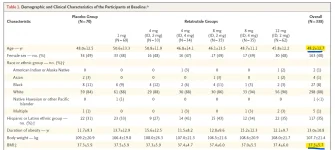
Thanks for your thoughtful response. In the participant data, did you find if any of the test subjects were under 48yo? (I could honestly be reading the table wrong, but it seems like that’s the lowest age.) And if I’m reading it correctly, 100% of the participants were “overweight or obese”.Grogu said:I’ve been thinking about your point about the generalizability of clinical study results when the study participant selection criterion is constrained and if the results from most (if not all) the clinical trials on glp-1 medications can be imputed upon the general population.
I looked at the SURMOUNT-1 participant criterion and it’s fairly restrictive. More restrictive than I originally remembered. But most of the protocol appears to be centered on finding generally healthy folks who meet the treatment criteria and don’t have confounding medical conditions which could affect the results or cause harm to the participant. For example, excluding people with a medical history of MTC or MEN or lifetime history of suicide attempt is probably because these are low in the general population. These two are clearly about no harm to the participant. But I’m sure that study researchers spend significant amount of time on these decisions so that the results are generalizable, otherwise the FDA wouldn’t accept the results. They probably have to justify the criterion with science.
TL/DR, just because there is a participant selection criterion and that everyone isn’t eligible to participate in the study doesn’t mean that the results can’t be extrapolated to the population.

FortySeven said:Thanks for your thoughtful response. In the participant data, did you find if any of the test subjects were under 48yo? (I could honestly be reading the table wrong, but it seems like that’s the lowest age.) And if I’m reading it correctly, 100% of the participants were “overweight or obese”.
Out here in the wild Wild West of rat experiments, we have folks (including me) whose BMIs have never been above a high “normal”.
quoted said:If a study were conducted to determine the percentage of the population of people as a whole who are non-responders to retatrutide, the study population would have to be expanded, no?
FortySeven said:All I am saying is that the New York Times took a statistic and reduced it to a false claim by using the broad stroke “people”.

Me too. Was going out of pocket on prescription Sema, and actually gained weight. Gave that up pretty quick.miss-sanne said:I have a lot of patients who never respond to Wegovy, the one we use mostly in Denmark.
It was the same for me, Wegovy gave me nothing.
Good question to ask! Easy to make a mistake. Other variables, too. For example, I just discovered today that my knock-off Amazon-sourced pen was consistently giving me 3.5 to 4 units when the dial was set to 10. Had that continued, I might have been unhappy with my results for that particular peptide (GHK-Cu in this case).Foggy-Hollow said:Someone had posted a claim some time ago (late last year maybe?) they didn’t get any loss until they hit 15mg of tirz.
I asked how they mixed their vial and they never responded.
Okay I love learning new stuff, and I learned a lot from your post! Thank you!Grogu said:Your post gave me a lot to think about.
In the phase 2 retatrutide clinical trial the average age was 48.2 (last column) but the number next to it is the +/- standard deviation. The 12.7 is in years and this is one standard deviation from the mean (average). Two standard deviations capture about 95% of a given population. So, 95% of the participants were between the age of 22.8 and 73.6. So, there were definitely some people younger than 48. Same for BMI. Average BMI was 37.3, but with a 5.7 standard deviation, there were definitely folks with a BMI in the high 20s. But remember that these medication were designed for the clinically obese and those overweight with commorbidities.
View attachment 17561
You'd be surprised how small a sample needs to be to draw conclusions about a population, if proper statistical methods are followed. It could be as low as 30. But I don't think anyone would ever design a sample to test a population that the medication was never designed to treat. That makes no sense at all.
The NYT article says, "....But one in 10 people are what scientists call “non-responders."
The implication is that it's 1 in 10 people (who take the medication) will be non-responders. Because you can't be a non-responder if you don't take the medication. And the only people who are supposed to be taking the medication are those with the clinical indications. And hence why the study was designed to select a sample of that population.
They never said 1 in 10 people in the world, because the entire general public shouldn't be taking the medication.
FortySeven said:Okay I love learning new stuff, and I learned a lot from your post! Thank you!
, and some of the stuff is sloppy because most doctors conducting medical research aren’t trained in statistical methods. The principal investigator on both the tirzepatide and retatrutide studies (Dr. Jastreboff) is a MD and PhD and she has backing of EL. The studies are super solid.

FortySeven said:I didn’t say “lazy science”, I said, “lazy science reporting.” Two verrrrrrrry different things. All I was pointing out is that one in 10 people in a scientific study population is not the same thing as one in 10 people in the general population. That’s it. It’s a subtle issue of semantics, but it’s the sort of misinformation that gets perpetuated. I don’t think you even read my response closely enough to understand what I was saying, which is not questioning the validity of the study—nor its results—but rather questioning the translation of the study’s findings into the subheading of the article.
1:10 clinical trial participants does not equal 1:10 people. It’s not my opinion—it’s statistics.
I am a NYT subscriber. Their reporting is generally exceptional.
I didn’t jump over anything, and I’m certainly not on any sort of quest. I am, however, a critical thinker, and I encourage others to be as well.
I wanted to apologize. You are correct in that I did misread your response last week. I stand corrected.FortySeven said:I didn’t say “lazy science”, I said, “lazy science reporting.” Two verrrrrrrry different things. All I was pointing out is that one in 10 people in a scientific study population is not the same thing as one in 10 people in the general population. That’s it. It’s a subtle issue of semantics, but it’s the sort of misinformation that gets perpetuated. I don’t think you even read my response closely enough to understand what I was saying, which is not questioning the validity of the study—nor its results—but rather questioning the translation of the study’s findings into the subheading of the article.
1:10 clinical trial participants does not equal 1:10 people. It’s not my opinion—it’s statistics.
I am a NYT subscriber. Their reporting is generally exceptional.
I didn’t jump over anything, and I’m certainly not on any sort of quest. I am, however, a critical thinker, and I encourage others to be as well.
no problem. turns out I was wrong on a few points, as explained by @Grogudickybob said:I wanted to apologize. You are correct in that I did misread your response last week. I stand corrected.


