A.I. told me this was the optimal stack schedule, I'm skeptical

Status
Not open for further replies.
jason370 said:
Alternating TSM10, IP10, and CP20 because they overlap in metabolic lanes. What are your thoughts on how to best optimize this stack? I'm not saying it is right, I'm saying I'm confused now, and would appreciate the wisdom and expertise of this community.

View attachment 22349
What is your goal with this stack? (For what goal do you want to optimize?)

Also (just a tip),

When asking AI, feed it reliable information first (e.g. scientific articles from pubmed) and tell it specifically to only look at that data. Asking ChatGPT (or any LLM) at random will not give very reliable results.

I personally use NotebookLM (and Zotero) to curate the data fed into the AI.
 
DrPEPr said:
What is your goal with this stack? (For what goal do you want to optimize?)

Also (just a tip),

When asking AI, feed it reliable information first (e.g. scientific articles from pubmed) and tell it specifically to only look at that data. Asking ChatGPT (or any LLM) at random will not give very reliable results.

I personally use NotebookLM (and Zotero) to curate the data fed into the AI.

attachments-1778782575988-webp.23234.webp
 

Attachments

  • attachments-1778782575988-webp.23234.webp
    attachments-1778782575988-webp.23234.webp
    32.1 KB · Views: 0
AI is useful if you are responsible and think critically. It once said MA was a 2 party consent state for recording audio and it took about ten minutes of arguing for me to get it to admit it is a 2 party knowledge state (big difference). Argue with the AI, challenge it, demand receipts, it's such a powerful tool if you use it right.

Also, use different AI. I asked ChatGPT about a peptide stack and it told me not to do it because it was a high risk polypharmacy gamble. Grok gave me real answers. Deepseek went a step further and suggested steroids.
 
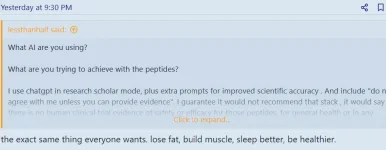
The simplest and easiest way to get fairly good pharmacology advice from an AI is just use the research/scholar mode on chatgpt, at least it is not generally going to recommend treatments never tested on humans. Fairly elaborate prompting can get even better answers, I just got it to write one for me focusing on scientific accuracy and reducing hallucinations and not agreeing with me without evidence. And then just copy paste it into new conversations.
 
mybodyisasewer said:
It once said MA was a 2 party consent state for recording audio and it took about ten minutes of arguing for me to get it to admit it is a 2 party knowledge state
At least your college education is still usable for some things
 
lessthanhalf said:
The simplest and easiest way to get fairly good pharmacology advice from an AI is just use the research/scholar mode on chatgpt, at least it is not generally going to recommend treatments never tested on humans. Fairly elaborate prompting can get even better answers, I just got it to write one for me focusing on scientific accuracy and reducing hallucinations and not agreeing with me without evidence. And then just copy paste it into new conversations.
that's exactly what i do
 
Unfortunately the quality of the answers depends a lot on the quality of the questions. I have found it excellent for difficult pharmacology questions , definitely at specialist doctor level. But having medical training means I use the correct terminology, which makes a lot of difference.

At this point even fairly standard AIs are at least as good as average doctors and the newer thinking models are a fair bit better and close to specialist level, and sometimes better, if you feed them all the right information.

When people or patients input the information , leaving bits out and not always knowing what parts of the story are most important , and not using medical language, their performance drops like a stone and they make fairly serious errors of judgement like not telling people to go to hospital, for serious emergency problems when any vaguely competent doctor would see the issue and its importance very quickly. It is this extreme unevenness in their performance that can make relying on them dangerous. But if your doctor asks it something the chances are they will get a very good answer, though I doubt too many do this in front of patients .
 
lessthanhalf said:
Unfortunately the quality of the answers depends a lot on the quality of the questions. I have found it excellent for difficult pharmacology questions , definitely at specialist doctor level. But having medical training means I use the correct terminology, which makes a lot of difference.

At this point even fairly standard AIs are at least as good as average doctors and the newer thinking models are a fair bit better and close to specialist level, and sometimes better, if you feed them all the right information.

When people or patients input the information , leaving bits out and not always knowing what parts of the story are most important , and not using medical language, their performance drops like a stone and they make fairly serious errors of judgement like not telling people to go to hospital, for serious emergency problems when any vaguely competent doctor would see the issue and its importance very quickly. It is this extreme unevenness in their performance that can make relying on them dangerous. But if your doctor asks it something the chances are they will get a very good answer, though I doubt too many do this in front of patients .
so, thoughts on my stack and how to make it more efficient?
 
In terms of the most important to least important. 1. exercise/lifting 2. reta 3. tesamorelin

I am in general fairly skeptical about a lot of the popular peptides, given that despite everyone saying how well they work, if they have never had any human testing, they are by definition not safe, and it is pretty doubtful they do what is claimed - this applies especially to KLOW and GLOW. I already explained my logic on it.

DSIP , really have not read the research. Melatonin is very well studied and non addictive and at doses less than 4mg /day is generally regarded as safe.

Tesa on its own is simpler and safer than 3 different GH/ghrelin/IGF-1 raising drugs, at least it has quite a few human studies in HIV lipodystrophy and one in diabetes, which surprised me by not showing increased sugar levels, I do not really understand why this is the case.

The biggest disadvantage of 3 peptides instead of one is increased risk of side effects and allergic responses, and the difficulty in working out what is responsible if adverse effects appear. And the ghrelin agonist could increase weight. Tesa does seem to have a high chance of developing allergies, mostly localised, but in another thread here, there might be a chance of anaphylaxis. So maybe get an epi pen, and stop if any evidence at all of an immune reaction separate to the injection site. The fact that this is known for tesa is because it has had a decent amount of human testing. It is unlikely the same info exists for cjc or ipamorelin.

AOD , I am fairly sure does not work.
 
Status
Not open for further replies.

Trending content

Members online

No members online now.

Forum statistics

Threads
2,620
Messages
55,146
Members
1
Latest member
Admin
Back
Top

