
Doctors don't go by letter and word probabilities, I would assume.



What is your goal with this stack? (For what goal do you want to optimize?)jason370 said:Alternating TSM10, IP10, and CP20 because they overlap in metabolic lanes. What are your thoughts on how to best optimize this stack? I'm not saying it is right, I'm saying I'm confused now, and would appreciate the wisdom and expertise of this community.
View attachment 22349

DrPEPr said:What is your goal with this stack? (For what goal do you want to optimize?)
Also (just a tip),
When asking AI, feed it reliable information first (e.g. scientific articles from pubmed) and tell it specifically to only look at that data. Asking ChatGPT (or any LLM) at random will not give very reliable results.
I personally use NotebookLM (and Zotero) to curate the data fed into the AI.


At least your college education is still usable for some thingsmybodyisasewer said:It once said MA was a 2 party consent state for recording audio and it took about ten minutes of arguing for me to get it to admit it is a 2 party knowledge state
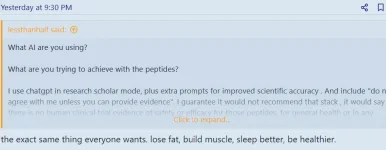
that's exactly what i dolessthanhalf said:The simplest and easiest way to get fairly good pharmacology advice from an AI is just use the research/scholar mode on chatgpt, at least it is not generally going to recommend treatments never tested on humans. Fairly elaborate prompting can get even better answers, I just got it to write one for me focusing on scientific accuracy and reducing hallucinations and not agreeing with me without evidence. And then just copy paste it into new conversations.
so, thoughts on my stack and how to make it more efficient?lessthanhalf said:Unfortunately the quality of the answers depends a lot on the quality of the questions. I have found it excellent for difficult pharmacology questions , definitely at specialist doctor level. But having medical training means I use the correct terminology, which makes a lot of difference.
At this point even fairly standard AIs are at least as good as average doctors and the newer thinking models are a fair bit better and close to specialist level, and sometimes better, if you feed them all the right information.
When people or patients input the information , leaving bits out and not always knowing what parts of the story are most important , and not using medical language, their performance drops like a stone and they make fairly serious errors of judgement like not telling people to go to hospital, for serious emergency problems when any vaguely competent doctor would see the issue and its importance very quickly. It is this extreme unevenness in their performance that can make relying on them dangerous. But if your doctor asks it something the chances are they will get a very good answer, though I doubt too many do this in front of patients .


