Weight regain after stopping GLP's

Status
Not open for further replies.

lessthanhalf

GLP-1 Specialist
Member Since
Jun 27, 2025
Posts
1,062
Likes Received
3,321
Location
melbourne
I thought this study was interesting

Trajectory of weight regain after cessation of GLP-1 receptor agonists: a systematic review and nonlinear meta-regression

https://www.thelancet.com/journals/eclinm/article/PIIS2589-5370(26)00043-X/fulltext

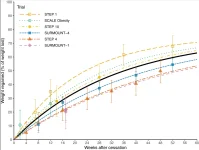
It shows that people who lost weight on GLP's might only regain 75% of the weight they lost long term which is interesting, really only adds up to about a 5% weight loss in the end, which is better than nothing, but I think it is now realistic to think that 20-30% is actually feasible, using tirzepatide or retatrutide and staying on it. And even possibly more if you get into higher doses or more experimental combinations.

The graph of weight regain does seem to be leveling out after a while, it would be interesting if they could work out why and what might be being changed long term. I do not really believe the articles explanation of better food choices.
 
I think for most people, staying on a maintenance dose is going to be the only realistic way to keep off the weight.

Some people who mostly stayed at a normal weight throughout their lives but gained weight from a specific short-term issue like a medication or pregnancy might be able to use the GLP1 to lose that weight and then stop and maintain on their own.

I think most people who struggle with obesity have done so for a good portion of their adult lives so their brain is wired to want to eat way more than they need.
 
I tried a couple of times to post the jpg of the graph but it just comes up blank. It is in the journal article if you want to look at it. I have been able to upload pdfs before without problems , don't know what it does not like about the image?
 
I think all the other benefits far outweigh the costs of taking it for the rest of ones life. It's far cheaper than supplements, and high blood pressure, cholesterol and insulin medication. It only gets more expensive when you get hooked on chasing the other peptides. But again, your increasing your healthspan. One quad bypass, or a few stents cost more than a lifetime of GLPs.
 
Here you go:

attachments-1773022825551-webp.17188.webp

on the other hand, there are some dedicated people who continue to choose a healthier lifestyle after they quit GLP-1 RAs and maintain or even lose a few more pounds. You can't just sit around, eat, and think you're gonna get smaller.

Edit: and there are people who cycle it, go 4 weeks without, let your system refeed, gain ~10% back, then use the reta again and again. Cheaper that way maybe.
 

Attachments

  • attachments-1773022825551-webp.17188.webp
    attachments-1773022825551-webp.17188.webp
    69 KB · Views: 0
PAPoots said:
I think all the other benefits far outweigh the costs of taking it for the rest of ones life. It's far cheaper than supplements, and high blood pressure, cholesterol and insulin medication. It only gets more expensive when you get hooked on chasing the other peptides. But again, your increasing your healthspan. One quad bypass, or a few stents cost more than a lifetime of GLPs.
I completely agree with the above statement, for grey GLP's it is a no brainer, whether it is true at full retail prices is a bit harder to determine.

Sadly all the cost effectiveness analysis studies I have seen so far all say they are too expensive per QALY gained ( quality of life year ) , and will be until they get a lot cheaper. Once they say otherwise countries like Aus will start subsidising them a bit more widely, although it won't help much in countries where the government is not subsidising medication costs. I am not sure the studies are doing a complete job of including all the very long term medical cost savings in their analysis, but not all the science there is conclusive yet.
 
What's fascinating to me about these sort of studies is that the weight regain rate isn't closer to 100%, which is where I'd expect most people to land within 5 years of discontinuing treatment (assuming no other significant lifestyle changes).
 
i always think its funny when people mention to me ill gain the weight back when i stop taking it. i always respond

"yea as apposed to diet and exercise which we all know famously you only have to do one time and you'll be lean and muscular the rest of your life... oh wait..."

that always gets a rise out of people

but on a more serious note about the topic. i have seen several times allready in my short time here people discussing how they are planning on/just upped/wanting to up their dose when they are already at high doses of at least one glp if not multiple. and will often times even say they aren't hungry and have no food noise to deal with but arent losing weight. and ive wondered what they are doing to work with the meds rather than just let them do all the work. like it is doing exactly what it is supposed to do, keep hunger at bay and food noise non existent. what is the goal? to be physically unable to eat? because it seems like that is what they want rather than learn how to eat better or use exercise to get the caloric deficit that is needed. (obviously dietary restrictions/ allergies and physical limitations have their own needs to consider)

the ones that don't learn anything from the meds im sure are going to put all the weight back on where as the ones that use them to learn why they eat the way that they do and learn to overcome those hurdles wont. i know they helped me identify the triggers to my binge eating so i could avoid them more easily and realize when i am going into a binge and can get out of it (normally about 1/3 of the way through) because ill have that moment of "man its getting kinda late why am i still up? oh im eating, normally im in bed by now" like shit im doing it again and drop what im shoving in my mouth, leave the kitchen and come back when im not in that episode.
 
bbbilly said:
i always think its funny when people mention to me ill gain the weight back when i stop taking it. i always respond

"yea as apposed to diet and exercise which we all know famously you only have to do one time and you'll be lean and muscular the rest of your life... oh wait..."

that always gets a rise out of people

but on a more serious note about the topic. i have seen several times allready in my short time here people discussing how they are planning on/just upped/wanting to up their dose when they are already at high doses of at least one glp if not multiple. and will often times even say they aren't hungry and have no food noise to deal with but arent losing weight. and ive wondered what they are doing to work with the meds rather than just let them do all the work. like it is doing exactly what it is supposed to do, keep hunger at bay and food noise non existent. what is the goal? to be physically unable to eat? because it seems like that is what they want rather than learn how to eat better or use exercise to get the caloric deficit that is needed. (obviously dietary restrictions/ allergies and physical limitations have their own needs to consider)

the ones that don't learn anything from the meds im sure are going to put all the weight back on where as the ones that use them to learn why they eat the way that they do and learn to overcome those hurdles wont. i know they helped me identify the triggers to my binge eating so i could avoid them more easily and realize when i am going into a binge and can get out of it (normally about 1/3 of the way through) because ill have that moment of "man its getting kinda late why am i still up? oh im eating, normally im in bed by now" like shit im doing it again and drop what im shoving in my mouth, leave the kitchen and come back when im not in that episode.

I agree and after I get somewhere I am satisfied with I plan on staying on a maintenance dose for a very long time. At the very least until something better comes out or maybe even forever.
 
When I switched from Ozempic to Reta, it took a few weeks, maybe a month to get up to a dose that worked for me. I gained weight the whole time. I can probably live with a once a week injection a lot longer than I'll keep up with working out 5 days a week. For now, I have both 😁
 
If it takes constant mental effort to not eat as much as your body tells you too , all the evidence says that nearly everyone puts the weight back on eventually.

GLP medications solve this problem to a large degree. If you keep taking them.

I managed to get to a normal bmi 65kg and stayed there nearly 3 years a decade ago but eventually got depressed and started not caring and put it all back on and more 145kg. Did it again in 2022 23, using a diet specially designed to minimise hunger and avoid triggering binge eating, and kept it off for a year, but it was constant work every day to eat less than my hunger said I should be eating, and it is tiring. Thankfully I worked out it was just possible to afford low dose ozempic, and a year later discovered cheap pirate chinese peptides. Since being on 15 mg of tirz and 5mg of reta I have slowly lost another 13kg to get to 66kg, without constant forcing myself to eat less, still sticking to an extremely strict no high calorific density/ highly rewarding foods diet but at least it seems to be something I could live with long term.

One of the issues with using GLP medications to train yourself into better dietary patterns is that you cannot possibly know how much of those better patterns are due to the drugs, they get people to eat healthier foods with no conscious effort anyway. So that when you stop them, it is possible that those better patterns, that you thought were under conscious control, suddenly vanish, and you are left feeling bad and out of control of your eating and gaining weight, and stopping that whole yoyo pattern is what GLP drugs can offer. I had already trained myself into a very healthy eating pattern and lost 65 to 70 kg but it did not solve the problem of being nearly permanently hungry, but GLP medications did, or at least helped a lot.
 
lessthanhalf said:
One of the issues with using GLP medications to train yourself into better dietary patterns is that you cannot possibly know how much of those better patterns are due to the drugs, they get people to eat healthier foods with no conscious effort anyway. So that when you stop them, it is possible that those better patterns, that you thought were under conscious control, suddenly vanish, and you are left feeling bad and out of control of your eating and gaining weight, and stopping that whole yoyo pattern is what GLP drugs can offer. I had already trained myself into a very healthy eating pattern and lost 65 to 70 kg but it did not solve the problem of being nearly permanently hungry, but GLP medications did, or at least helped a lot.

Your point about permanent hunger without GLP-1s is key. If obesity is a disease, which the medical community has come to recognize, then GLP-1s treat that disease. The underlying pathology is a dysregulation of the mind-gut hormonal signaling system, and no amount of behavioral modification can correct that. Willpower and habit formation operate at the conscious level; the hormonal imbalance driving hunger operates well below it.

This is precisely why using GLP medications to "train yourself into better dietary patterns" is a flawed framework and why we see patient weight regain after stopping treatment. You cannot know how much of any behavioral improvement is attributable to the drug itself, since GLP-1s drive healthier food choices without conscious effort. When patients stop, those seemingly acquired habits can vanish, not because of weakness, but because the underlying signaling system reasserts itself. The result is the familiar cycle of relapse, guilt, and weight regain.

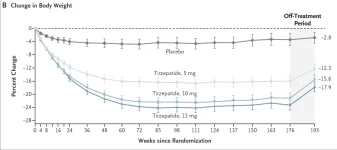
The true "miracle", at least to me, of these glp-1 medications is an off ramp from the yo-yo. As long as treatment is continued, weight stabilizes and plateaus at the new weight and appears to be sustainable in the long-term.

attachments-1773656061748-webp.17639.webp
 

Attachments

  • attachments-1773656061748-webp.17639.webp
    attachments-1773656061748-webp.17639.webp
    40.9 KB · Views: 0
It's clear that the only long term solution is to make lifestyle changes, and what you eat is the most important metric for weight loss. Physical activity is essential for health, but it won't help weight loss if the diet is not satiating. Eating satiating food is the solution. If you are not getting the signal to stop, you will overeat. GLP-1 could help in starting the journey to better health, but it can't be the only change.
 
Flexon said:
It's clear that the only long term solution is to make lifestyle changes, and what you eat is the most important metric for weight loss. Physical activity is essential for health, but it won't help weight loss if the diet is not satiating. Eating satiating food is the solution. If you are not getting the signal to stop, you will overeat. GLP-1 could help in starting the journey to better health, but it can't be the only change.
There is no doubt that diet and exercise can cause weight loss. What the evidence says , is that it does not work long term for nearly everyone, only about 5% or so of people who have massive weight loss from diet and exercise , or GLP's that then stop the GLP's, keep that weight off or most of it off long term. There are thousands of studies. So as far as I am concerned it is not an effective treatment. When there were no better options, it was definitely better than nothing and even medium term improvements of 5 to 10% can improve metabolic health. GLP medications can realistically cause 20 to 29% long term weight loss on average for tirz or reta.

I think there is pretty good scientific evidence that the appetite control system in people with severe obesity is pretty broken, and that losing weight does not fix it. Eating satiating food in the right amounts for health is not going to provide the correct signals to stop eating if the system controlling eating is not working properly. And after large weight loss metabolic adaptation to low calorie input requires eating quite a lot less calories to maintain weight than an equivalent weight person who had not lost weight. And hunger signalling is increased by weight loss. These 2 effects independently of broken appetite regulation make maintaining weight loss extremely hard.

I lost about 70kg with diet and exercise without glp's in 2022-2023, I had to maintain a calorie intake of about 1600 kcal/day to maintain weight, and despite a very carefully designed diet , I was hungry most of the time, and going on past experience , sooner or later putting the weight back on was the most likely outcome. Thankfully after about a year of this, GLP medications became an option instead.

GLP drugs help to lose weight and are equally effective at keeping it off long term so long as you keep taking them. Obviously eating a healthy diet and exercising is a good thing, but weight loss and the health benefits of these medications do not require this to work. The health benefits are no doubt larger if diet is good and exercise is happening, but GLP medications do improve food choices without any effort. And make exercise easier and safer after weight loss.

So comparing lifestyle changes to GLP therapy , one works OK in the short term with extremely low long term success rates and the other is more effective in the short, medium and long term in causing and maintaining weight loss. It really is that simple, one works, the other does not.
 
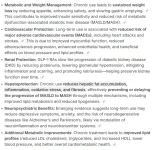
Beyond that, GLP1s are showing some other benefits that are linked to longevity:

attachments-1773710412121-webp.17697.webp

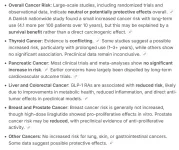
and even more than that but the panel is still open regarding cancer:

attachments-1773710515943-webp.17698.webp

but there are still worries. The gallbladder issues is a major one, but add some TUDCA; it maybe a requisite!

And yes AI helped me, but you know, I've read and watched a bunch and already knew this 😀

Anyways, why would I want to right out quit for again?
 

Attachments

  • attachments-1773710412121-webp.17697.webp
    attachments-1773710412121-webp.17697.webp
    125.4 KB · Views: 0
  • attachments-1773710515943-webp.17698.webp
    attachments-1773710515943-webp.17698.webp
    80.8 KB · Views: 0
One of the most interesting cancer studies is the one where it halved the death rate over several years in people who already had bowel cancer. This is an astonishing result , making it a more effective treatment for it than just about anything else except maybe the surgery to remove the tumour. Of course it may just be a fluke and cannot be replicated. Given the large number of cancers made more common by obesity and the early results strongly suggests they are less likely to occur on glp's, it could be a very important factor in cancers. There is a stack of ongoing research.
 
it kinda feels like we are all having the same mindset, but on opposite ends of the spectrum. we all agree GLPs are helpful, needed and effective. i feel like we are all kind of discussing different levels of dependance on them rather than the use of them as a tool. i myself find even taking 1.25mg/week of my tirz puts me in a much better state of mind to be able to make the right decisions when its needed and to pull myself back from the cliff of a binge. i dont want to waste the meds or set myself back from my progress i want and that thought is what helps me break the cycle, and even when i was off of it for 6 months i knew that just because i was hungry didnt mean i had to eat, so i just ate the same things everyday regardless of hunger levels.

some people seem to rely solely on the meds to achieve their goals. i mean just look at the number of threads in the fitness/nutrition category vs any other non specialized section here. if you stop the meds of course you will gain the weight back. same thing with if you stopped food tracking and/or exercise, i don't think anyone is arguing otherwise. i just personally feel like an over dependance on them will lead to these statistics to stay true, and anecdotally i would guess the ones that you see saying "im not hungry at all but im not losing weight" would be the reason they stay at 95% weight regain after quitting.

so people like me are viewing it from the angle of diet and exercise first then meds, compared to (admittedly most likely people that would be outliers in the studies mindset based only on the limited comments from forums like these without knowing all the work they put into weight management) meds as the heavy lifter and only thing that works.

again im unaware of any studies on this subject aswell, but ive seen a regular thought process from naturally thin people to be "ya im hungry but i dont have time to eat right now so ill just eat later." its not as much of a matter of hunger ques but more so mental awareness on what hunger ques mean, and would be interested to see what would happen if they had a super effective GLP that did nothing but remove the food noise completely., while leaving the appetite suppression and gastric emptying alone. what those studies would look like.
 
Status
Not open for further replies.

Trending content

Members online

No members online now.

Forum statistics

Threads
2,419
Messages
51,228
Members
1
Latest member
Admin
Back
Top