It actually happened: off statins!

Status
Not open for further replies.
Redneck doctoring: Women generally age slower than men cardiovascularly, so men might as well consider statins (even at low doses) for at least a small competitive boost for anti-aging or healthspan (in addition to everything else, including GLPs, diet, and exercise):

Gemini said:
Concept ​
Mechanism & Study Reference ​
The "Competitive Boost" Logic ​
The Gap JACC (2020): Women show slower progression of vascular aging across the lifespan compared to men. Men use statins to "offset" the biological 10-year head start women have in arterial plaque accumulation. ApoB & LDL-Years JAMA (2019): Long-term exposure to lower LDL-C/ApoB levels is associated with a 54% lower risk of CHD per mmol/L. Low-dose statins early in life mimic the "low-exposure" environment women naturally have pre-menopause. Plaque Stability PARADIGM Study: Statins promote plaque calcification and reduce high-risk "soft" (non-calcified) plaque volume. Protects men from the "vulnerable" plaque ruptures that typically cause premature male cardiac events. Inflammation JUPITER Trial: Statins significantly reduce hsCRP , even in individuals with "normal" cholesterol but high inflammation. Counteracts "inflammaging," a key driver of rapid biological aging in the male vascular system. Endothelial Function Circulation Research: Statins increase eNOS (Nitric Oxide) activity, improving vessel dilation and health. Maintains "younger" vessel responsiveness, directly targeting the primary site of male cardiovascular decline. The "Side Effect" Gap Cleveland Clinic (2023): Women are significantly more likely to report statin-associated muscle symptoms (SAMS). Because men tolerate the "boost" better, they face fewer trade-offs in muscle performance and "thrive" factors.
 
GLP had zero effects on my lipids profile with the exception of trigs (stooped eating sugar and overall fewer calories intake = lowered trigs).

I have super high LP(a) and inflammation (Reta did not impact my inflammation levels, either!).

Had lipids NMR done and always terrible. Decided against CAC score, instead, simply assumed it is very high based on other tests. No need to add stress to my life with a confirmation of what is a given based on everything else, lol…

I refused statins but instead started Repatha and it got my ldl to 90. Added now zetia. And plan on staying on both long term, hoping it will minimize the risks for me!
 
aRareUnicorn said:
GLP had zero effects on my lipids profile with the exception of trigs
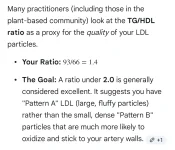
At the risk of sounding like a broken record here, a decrease in triglycerides (particularly the triglyceride to HDL ratio) is far more impactful on correlating with reduced heart disease risk than LDL. If GLPs brought your triglycerides down that is a very significant outcome:

https://pmc.ncbi.nlm.nih.gov/articles/PMC2664115
 
The evidence for lowering LDL looks pretty solid to me. This is a very large scale meta analysis.

doi: 10.1016/S0140-6736(10)61350-5. from the lancet Cited by 6102 - this is the number of scientific papers that referenced this study , a strong indicator of relevance and importance.

Efficacy and safety of more intensive lowering of LDL cholesterol: a meta-analysis of data from 170,000 participants in 26 randomised trials

main findings

Across all 26 trials, all-cause mortality was reduced by 10% per 1·0 mmol/L LDL reduction (RR 0·90, 95% CI 0·87-0·93; p<0·0001), largely reflecting significant reductions in deaths due to coronary heart disease (RR 0·80, 99% CI 0·74-0·87; p<0·0001) and other cardiac causes (RR 0·89, 99% CI 0·81-0·98; p=0·002), with no significant effect on deaths due to stroke (RR 0·96, 95% CI 0·84-1·09; p=0·5) or other vascular causes (RR 0·98, 99% CI 0·81-1·18; p=0·8). No significant effects were observed on deaths due to cancer or other non-vascular causes (RR 0·97, 95% CI 0·92-1·03; p=0·3) or on cancer incidence (RR 1·00, 95% CI 0·96-1·04; p=0·9), even at low LDL cholesterol concentrations.

CAC screening is complicated, there is not a lot of evidence that screening unselected populations is beneficial. Using it to decide on therapy or not for those with some risk factors but borderline 10 year risk is generally regarded as a good idea.

I cannot find a lot of supporting evidence , but I wonder if it is worth doing in a lot of people with severe obesity in those over 40 or 50, especially in the context of improved lipids and other risk factors after large weight losses from GLP's, where the numbers no longer look definitive for needing preventive therapies, but the odds of pre existing significant coronary artery disease is high. Both I and another person in this thread discovered very high ccs numbers, requiring secondary prevention level treatment. The science on obesity and cardiovascular risk is complicated and the standard risk equations do not include it.

It is always going to be harder to get good evidence for primary prevention, generally the older and sicker the population being studied the more events are going to happen, so secondary prevention is going to show effects in much smaller populations, whereas you might need 10 times the number of patients to show similar effects in a healthier primary prevention population which makes the study 10 times as expensive to have the same statistical power . It is similar to GLP's where they are proven to reduce illness and death in high risk populations - those with heart disease or diabetes, but in unselected groups showing this effect is much more difficult and expensive, so there is no proof yet and may not be for many years.
 
lessthanhalf said:
CAC screening is complicated, there is not a lot of evidence that screening unselected populations is beneficial. Using it to decide on therapy or not for those with some risk factors but borderline 10 year risk is generally regarded as a good idea.
Ahhhh......I just realized that I have an important clarification to make: As Ihave mentioned, I self-selected to have a CAC run via self-pay. Insurance was not involved. That however is not the clarification. My clarification is that the CAC led my cardiologist to want to look closer at the issue and then I had to do a CT Angiogram, and that was blurry, so insurance OK-ed a closer look via catheter and my cariologist told me that, while he was looking, if he could re medy whatever he might find with a stent he would and he did. That is the actual and literal order of operations and logic.
 
Calm Logic said:
Percentiles for calcium scoring, categorized by sex and age:

Checking your browser - reCAPTCHA

200-b8f670c0b8b0.gif

Someone I know got a score waaay outside these tables.

I wonder what happened to him 😉

This calcium score test could turn out to be the best $99 he spent in his life, who knows.
 

Attachments

  • 200-b8f670c0b8b0.gif
    200-b8f670c0b8b0.gif
    56.9 KB · Views: 0
lessthanhalf said:
It is always going to be harder to get good evidence for primary prevention, generally the older and sicker the population being studied the more events are going to happen, so secondary prevention is going to show effects in much smaller populations, whereas you might need 10 times the number of patients to show similar effects in a healthier primary prevention population which makes the study 10 times as expensive to have the same statistical power .
Of course primary prevention is where most of the money is when it comes to any prescription drug...

As a thought problem, let's pretend that every now and then pharma will exaggerate results, minimize side effects, or otherwise behave unethically if it financially benefits them. If that's a possibility, it would be wise to look for signs that might be happening. A major red flag for that would be a desire to closely guard the raw data from statin trials for primary prevention and ensure that only pharma-funded and very select groups of researchers are ever able to access that data.

Enter the CTT at Oxford University. They seems to do exactly what I just suggested would be a major red flag. They'll claim that their hands are tied due to confidentiality agreements with the researchers who gathered the data and that's likely true. But who are these "evil" researchers who refuse to release such important health data with such broad life-saving implications and will only let select groups of researchers access it to perform analysis on the benefits and side effects associated with statins? Weird, eh? I wonder what their rationale is for being willing to show their results to the world, but refusing to show their analysis work in getting from the raw data to the end result.
 
tubby said:
At the risk of sounding like a broken record here, a decrease in triglycerides (particularly the triglyceride to HDL ratio) is far more impactful on correlating with reduced heart disease risk than LDL. If GLPs brought your triglycerides down that is a very significant outcome:
I would agree with you if… HDL was reasonably normal range. In my case it is at 30 mg/dl and the ratio remains high even with trigs lowered to 90 mg/dl… yes the ratio is now lower but by any means the risk has not improved…
 
krsct said:
Been on GLP-1 for almost 3 years. Lost 1/4 of body weight in 8 months and maintenance since then. Took a while but my doctor stopped my statins today. Never thought it would happen. It took a while but another great NSV.
Congratulations!!! It is so amazing when you reach a milestone you've been working so hard for.
 
lessthanhalf said:
Without knowing the full story it is hard to say if this is a good idea or a bad one. The purpose of statins is to reduce risk of cardiovascular disease either in the first place or after an event like heart attack or stroke has occurred. If the original assessment of absolute cardiovascular risk over 10 years was high, and statins were started for that reason, then unless that assessment is recalculated, then staying on them is the correct approach regardless of lipid levels. If they are being used for secondary protection then stopping them is always the wrong move.

If the loss of weight and improved blood pressure, lipids etc were enough to reduce risk to below 10% over the next 10 years then stopping might be correct, but it is definitely not as simple as better lipid numbers after weight loss. Looking at statin use based on absolute cardiovascular risk is the correct way to view it but it is not super simple or obvious. Anyone who has or had severe obesity is likely to have high absolute cardiovascular risk, and there is a fairly high chance of that still being the case if weight is lost especially if older. And there is a reasonable chance that damage has already occurred that will not be known about unless it is looked for.

I ended up diagnosed with early heart failure and coronary artery disease after losing a lot of weight and without symptoms, where treatment with statins and other medications reduce 10 year risk from about 25% to about 12%, but if it had not been looked into I would not have known until a heart attack years later, which might still happen , but being half as likely sounds good to me.
You should do some real research on this there is no real proof that high cholesterol causes heart attacks or heart disease. Statins are terrible for you.
 
tubby said:
only let select groups of researchers access it to perform analysis on the benefits and side effects associated with statins?
I hate this timeline.

Hiding is for cowards, science is based off of independent repeatability.

I’m reading up on the whole niacin thing and the obfuscation… sigh. I’ll go back to working with nuts.

Bolts and nuts.
 
samIam said:
You should do some real research on this there is no real proof that high cholesterol causes heart attacks or heart disease. Statins are terrible for you.
Low-density lipoprotein cholesterol and lifespan

quoted said:
This genetic evidence supports that higher LDL-c levels reduce lifespan and longevity.

A separate issue is how much statins help. If cardiovascular risk factors are less, the benefits of statins will be less obvious for primary prevention:

Gemini said:
The Hierarchy of Heart Health: Ranked Cardiovascular Risk Factors (2026) ​

Based on the 2026 Heart Disease and Stroke Statistics Update from the American Heart Association (AHA) and the latest CDC clinical data, risk factors are prioritized by their statistical impact on mortality and their "population attributable fraction."

The primary ranking is now centered on Life’s Essential 8 , a framework that splits risk into health behaviors and health factors.

Master Risk Table: Impact and Prevalence

Rank Risk Factor Impact Category Key Statistic / Clinical Threshold Primary Source 1 High Blood Pressure Health Factor >130/80 mmHg; linked to ~50% of CVD deaths. AHA 2026 Statistics Update 2 Tobacco & Nicotine Health Behavior Leading preventable cause; 2–4x higher risk. CDC / AHA Expanded Chapter 3 High Cholesterol Health Factor Focus on Non-HDL and ApoB levels. AHA 2026 (Life’s Essential 8) 4 Blood Sugar / Diabetes Health Factor HbA1c > 6.5%; 2x risk of heart attack. CDC NHIS 2026 Trends 5 Obesity (High BMI) Health Factor BMI > 30; drives 90% of CKM syndrome. AHA CKM Syndrome Chapter 6 Physical Inactivity Health Behavior
 
samIam said:
You should do some real research on this there is no real proof that high cholesterol causes heart attacks or heart disease. Statins are terrible for you.
This is abject nonsense and anyone doing some "real research" and looking at the mind boggling amount of data supporting them will come to the same conclusion.

They don't work for everyone, and some people have unacceptable side effects, but that applies essentially to all medicine, whether peptide or other pharmaceutical.
 
Total cholesterol: 314

Triglycerides: 93

HDL: 66

VLDL Chol Calc: 19

LDL Chol Calc (NIH): 229

And this is after 3.5mg reta/week. Triglycerides and HDL both decently improved on reta no change for LDL.

Been like this for 25 years .. personally, don't have any risk factor of CVD on both sides of family. Doc wants me on a statin.
 
On the positive side, per Google Gemini:

[Imported image pending local asset: attachments-1000022356-webp.20034]

OTOH: "Most clinical guidelines still treat an LDL above 190 as a high-risk "threshold" regardless of how good the other numbers look" (Google Gemini).
 
tendency said:
Total cholesterol: 314

Triglycerides: 93

HDL: 66

VLDL Chol Calc: 19

LDL Chol Calc (NIH): 229

And this is after 3.5mg reta/week. Triglycerides and HDL both decently improved on reta no change for LDL.

Been like this for 25 years .. personally, don't have any risk factor of CVD on both sides of family. Doc wants me on a statin.
If your doctor wants you on a statin , it is most likely there is a reason. Family history is only one of many risk factors, the largest one by far is age, but also blood pressure, blood glucose, lipids , smoking , obesity. It is not hard to make an estimate of absolute cardiovascular risk from that information, and if high then statins and or other lipid lowering drugs are useful and reduce risk. No idea of the other risks but if you are taking reta then presumably weight is an issue, and the ldl numbers are pretty high. If lipids have been like that for 25 years then there has been lots of time to grow atherosclerotic lesions where you really do not want them to be, in coronary and cerebral arteries.
 
A possibile, additional cardiovascular risk factor:

tendency said:
I've always (well, last 25 years at least) had borderline high calcium measured via bloods, like, say 10.0, 10.1 (reference 8.7-10.2).

In any case, the chronically high LDL seems to be begging for a statin. Some docs do EOD dosing with Crestor (or Monday, Wed, Friday dosing) to prevent sides, which are apparently low in incidence anyway, much less frequent than believed.

As discussed earlier in this thread, a CT calcium score could help if you are on the fence, or could inform how low to get LDL.
 
Really hard to know without age, but if he has test results from 25 years ago then likely to be at least 45, which is old enough for risks to start being a real issue rather than some far away concern. And coronary calcium score is the ideal test to use if uncertain about starting statins or not , it classifies long term risk more accurately than standard risk factors in that situation.

Most people do not get any side effects from statins. Apart from rare muscle damage issues which are not hard to diagnose, the most common complaint by far is vague muscle soreness, but in large studies the odds of it on statins are more or less the same as for placebo.
 
lessthanhalf said:
Family history is only one of many risk factors, the largest one by far is age
From a marketing perspective, statins would have more traction if they were seen as anti-aging supplements (which is arguably what they are, in addition to being reactive treatments). Especially for men, since they age cardiovascularly about 9 years faster (on average).
 
Status
Not open for further replies.

Trending content

Members online

No members online now.

Forum statistics

Threads
2,620
Messages
55,146
Members
1
Latest member
Admin
Back
Top