Zydeceltico said:
@tubby
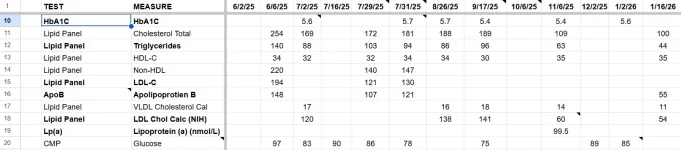
I am seriously interested in your take on my numbers.
I had my CAC on 10/8 and my PCP started me on rosuvastatin on 10/9.
My stent was placed on 12/9.
Again -seriously curious about your take. thx
I should add that I started tirzepatide on June 6, 2025.
SW: 242 lbs, GW 187 lbs reached 11/1/25 and have maintained since.
View attachment 18787
Let me preface this by saying that I'm not a doctor and you shouldn't listen to anything resembling medical advice that I might say. It's not medical advice and I'm not qualified to provide that.
I'd start by ignoring the LDL-C numbers entirely. On a basic lipid panel they don't actually measure LDL, they estimate it using something called the Friedewald Equation (Google that if interested in learning more). In addition, even if LDL-P (a proper measure of LDL that is actually a direct measure of it rather than a crude guess) was done, since you're going through a period of weight loss, that can bias your LDL result significantly, making it less reliable than it would be if you were at a stable weight prior to having the lab done.
However, looking at the numbers on your lipid panel that actually are strongly correlated with cardiovascular risk as well as directly measured rather than estimated (triglycerides and HDL), I do see some cause for concern there. At present, the best estimator of cardiovascular risk is the triglyceride to HDL ratio, which is much more strongly correlated with it than LDL-C. And honestly, that's not looking great. 140/34 = 4.1 is bad, but then that was before you started taking a GLP-1 and you don't need me to tell me that you were in bad shape before the GLP-1.
Jumping ahead to 9/17/25, your trig/HDL ratio is now 96/30 = 3.2. That's still bad, but a significant improvement over where you were before the GLP-1 and honestly a pretty positive change over a 3 month period. And honestly with such a rapid weight change in such a short period of time, I'd probably want to see things "settle" for a bit before making any sort of judgement call there.
Now jumping to your January numbers, 44/35 is looking a lot better at 1.3. Of course, getting to that ratio via a statin is very different than getting to that ratio via lifestyle changes. Just as holding a bunch of helium balloons as you step on the scale isn't going to lead to any of the health improvements that actually losing weight would come with, I don't know that examining statin-mediated numbers is really going to tell us anything useful there. Also, you probably have many years at which your cardiovascular system was under strain and built up plaque, which has to be factored in too.
The traditional school of thought with that is that by taking a statin you'll increase the amount of calcified plaque in your arteries. Normally that's a bad thing, since more calcified plaque means more cardiovascular risk. Of course, cardiologists being the dogmatic people that they are, upon discovering that rationalized it as actually being a good thing since it meant plaque was more stable and less likely to break off from a deposit (which could potentially be fatal). I can't say I disagree with them on that point to be honest, but just throw the dogmatic dig in there because, while likely true, it's also the kind of rationalization one would invent in trying to justify their own past actions and practices, and such things are probably worth considering when evaluating recommendations. They also have a long history of giving bad advice based on very limited evidence, but I digress...
Another school of thought (that hasn't been studied extensively) is to seek out other ways of reducing plaque deposits (natto kinase shows some promise there) rather than calcifying them, but I don't think that's well enough understood for a responsible recommendation to be made there, since one could argue that's just as easy to lead to catastrophe for you as improvement, based on things I don't know the answer to. But you kind of have to pick a lane there: Either stabilize/calcify the plaque via the traditional/statin route or attempt to actively reduce it somehow.
I guess my main takeaways going forward if I were you would be that your low HDL is hurting your trig/HDL ratio (if not for that, your triglycerides are at a really nice level right now). At the same time, you can't really trust your lipid panel numbers to tell you anything useful in the future, as they're biased by the statin that you're taking, making them suspect at best when applied to risk models that may conflate statin and statin-free numbers. I might consider seeking out an "LDL skeptical" doctor and pay for a consult with them. In the end there's a good chance they will also recommend staying on the statin that you're on, but they're going to have less blind spots than I will and be in a position to actually give you a proper recommendation.