Filtering Question...

Status
Not open for further replies.

tedvio

GLP-1 Apprentice
Member Since
Nov 12, 2025
Posts
42
Likes Received
99
Location
Canada
Just wondering, for those who filter, what are you doing to ensure the new vials you use are actually sterile? Is everyone literally using an autoclave? And if yes, does that mean you are buying vials, stoppers, caps, crimpers etc so that you can just bake the vials on their own then cap?

I see some vials available complete on Amazon Canada, but there are reviews that show they were dirty inside. I can't help but wonder how many people that are filtering are actually making the situation worse by using new vials that aren't as sterile as they think...

And to add a further, possibly dumb question........if I felt safer just using the original vial, is there a decent way to sterilize that during the filtering process? So for example, reconstitute with my bac water, draw all that into a syringe and set aside. Use another syringe to put new bac water (or iso alcohol??) into the empty vial, swirl, let it sit?, draw that back out, then push my reconstituted peptide back into the vial through the filter.. Seems like it would take the worry out of using a random vial off Amazon...
 
tedvio said:
Just wondering, for those who filter, what are you doing to ensure the new vials you use are actually sterile? Is everyone literally using an autoclave? And if yes, does that mean you are buying vials, stoppers, caps, crimpers etc so that you can just bake the vials on their own then cap?

I see some vials available complete on Amazon Canada, but there are reviews that show they were dirty inside. I can't help but wonder how many people that are filtering are actually making the situation worse by using new vials that aren't as sterile as they think...

And to add a further, possibly dumb question........if I felt safer just using the original vial, is there a decent way to sterilize that during the filtering process? So for example, reconstitute with my bac water, draw all that into a syringe and set aside. Use another syringe to put new bac water (or iso alcohol??) into the empty vial, swirl, let it sit?, draw that back out, then push my reconstituted peptide back into the vial through the filter.. Seems like it would take the worry out of using a random vial off Amazon...
Luckily I have a friend whose wife works as a compounding pharmacy. I get my vials and bac from them. If I didn't have this resource I would go with a low end autoclave and strilie them myself. Autoclave
 
tedvio said:
Just wondering, for those who filter, what are you doing to ensure the new vials you use are actually sterile? Is everyone literally using an autoclave? And if yes, does that mean you are buying vials, stoppers, caps, crimpers etc so that you can just bake the vials on their own then cap?

I see some vials available complete on Amazon Canada, but there are reviews that show they were dirty inside. I can't help but wonder how many people that are filtering are actually making the situation worse by using new vials that aren't as sterile as they think...

And to add a further, possibly dumb question........if I felt safer just using the original vial, is there a decent way to sterilize that during the filtering process? So for example, reconstitute with my bac water, draw all that into a syringe and set aside. Use another syringe to put new bac water (or iso alcohol??) into the empty vial, swirl, let it sit?, draw that back out, then push my reconstituted peptide back into the vial through the filter.. Seems like it would take the worry out of using a random vial off Amazon...

There was a recent thread that covered vial sterility concerns fairly well:

Empty sterile vials vials vials

I am ashamed to say I've been using those k2's from amazon they are cheap, clear and easy like me. But id rather spend a couple bucks per vial ( 2 dollars max bulk ) thinking peptidetest they have supposedly sterile vials for a little less than 2 bucks each, anyone have a current facorite vendor?

glp1forum.com
 
tedvio said:
Just wondering, for those who filter, what are you doing to ensure the new vials you use are actually sterile? Is everyone literally using an autoclave? And if yes, does that mean you are buying vials, stoppers, caps, crimpers etc so that you can just bake the vials on their own then cap?

I see some vials available complete on Amazon Canada, but there are reviews that show they were dirty inside. I can't help but wonder how many people that are filtering are actually making the situation worse by using new vials that aren't as sterile as they think...

And to add a further, possibly dumb question........if I felt safer just using the original vial, is there a decent way to sterilize that during the filtering process? So for example, reconstitute with my bac water, draw all that into a syringe and set aside. Use another syringe to put new bac water (or iso alcohol??) into the empty vial, swirl, let it sit?, draw that back out, then push my reconstituted peptide back into the vial through the filter.. Seems like it would take the worry out of using a random vial off Amazon...
Not a dumb question.

You can purchase sterile vials or pen cartridges online. With vials, make sure that the manufacturer lists the sterilisation method (steam, radiation, etc) before you buy. If they don't have that info handy, I wouldn't trust them. I prefer to go with the pen cartridges as they are relatively cheap and the sealed packet has an indicator for sterility.

As for sterilising your own vials, you can probably do that with an autoclave or a pressure cooker if you are so inclined. It's not a good idea to put in bac water or alcohol. Bac water only inhibits growth of new bacteria, not the ones currently in the vial and alcohol, if you're putting it in through the rubber then taking it out, you won't get all of the alcohol out of the vial. It would likely interact with your peptide.
 
bash-6e908e3ce0f3.gif
 

Attachments

  • bash-6e908e3ce0f3.gif
    bash-6e908e3ce0f3.gif
    1.7 KB · Views: 2
tedvio said:
And to add a further, possibly dumb question........if I felt safer just using the original vial, is there a decent way to sterilize that during the filtering process? So for example, reconstitute with my bac water, draw all that into a syringe and set aside. Use another syringe to put new bac water (or iso alcohol??) into the empty vial, swirl, let it sit?, draw that back out, then push my reconstituted peptide back into the vial through the filter.. Seems like it would take the worry out of using a random vial off Amazon...
You're confusing sterilizing with doing the dishes.
 
tedvio said:
I can't help but wonder how many people that are filtering are actually making the situation worse by using new vials that aren't as sterile as they think...

I've often thought this too! That the filtering and transfer process can actually provide the opportunity to introduce bacteria and then you're worse off than if you hadn't filtered and just reconstituted into the source vial.

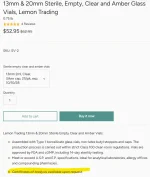
I think that the key is to purchase your supplies from reputable sources. There are actually COAs for sterile vials. Here is an example of a listing:

13mm & 20mm Sterile, Empty, Clear and Amber Glass Vials, Lemon Trading

Maintain drug purity with 13mm and 20mm sterile, empty clear and amber vials from Farris Labs. These are great for allergy offices & compounding pharmacies.

www.farrislabs.com

attachments-1779816436715-webp.24900.webp


Given how much money we save on peptides, the one thing that I don't scrimp on is supplies. For the price I go wild on supplies and buy from reputable sources and it's worth every $ spent.
 

Attachments

  • attachments-1779816436715-webp.24900.webp
    attachments-1779816436715-webp.24900.webp
    45.1 KB · Views: 3
DrPEPr said:
My 2cts:

I've sent a couple of aas samples in 'biomed solutions' vials (also Amazon) to jano for testing (inc. sterlility) and they all came back fine. So I guess they're ok.
Good to know. I have that brand on hand right now.
 
DrPEPr said:
My 2cts:

I've sent a couple of aas samples in 'biomed solutions' vials (also Amazon) to jano for testing (inc. sterlility) and they all came back fine. So I guess they're ok.
I got those from Amazon based on the reviews (maybe yours?). I know it isn't the best way to verify sterility but when I saw Jano mentioned, I figured it was someone who knew their peps so I got them.
 
Sterilize (not disinfect, sterilize) empty vials + vial parts with a pressure cooker. Boiling is not enough - spores survive. Pressure cooker at 15 PSI for several minutes gets it just hot enough to do the trick. Can use autoclave indicator tape to confirm sterilization conditions did in fact occur.

If you need vials completely dry, transfer to an oven.

As for avoiding re-contamination from the air, probably hard to do in a home setting. You can avoid some (a lot?) by loosely covering your bottles with aluminum foil while cooking / transferring. Can also mimic asceptic techniques, ie move your finished bottles to a more sterile room (surface and tools pre-prayed with 70% iso), wash your hands, wear a face mask, cover your hair, etc.

All that said, the risk of infection with a no-name vendor's "sterilized" vials seems pretty low, based on anecdotal evidence (would let others opine). There's a great interview online with Peter Magic (janoshik founder) who sort of makes fun of us for being germophobes (i.e., says using sterile water for reconstitution is totally fine for 28 days- BAC water not even used in Europe).

If you value your time and peace of mind, just go spend a little extra on premium supplies.

I find sterilizing bottles, crimping the tops, etc the whole process kind of fun!

Not sure why, though..
 
laansasa said:
I got those from Amazon based on the reviews (maybe yours?). I know it isn't the best way to verify sterility but when I saw Jano mentioned, I figured it was someone who knew their peps so I got them.
Yup, that is my review.

Didn't mention the AAS part there (for obvious reasons 😉 )

Just to be clear. I did not send empty vials to Jano specifically to get them tested.

I put samples that required testing in these vials.

I made the assumption that because the results came back negative for sterility and endotoxins (3 times / different samples now in total) the vials must be good too.
 
greenwave1015 said:
Sterilize (not disinfect, sterilize) empty vials + vial parts with a pressure cooker. Boiling is not enough - spores survive. Pressure cooker at 15 PSI for several minutes gets it just hot enough to do the trick. Can use autoclave indicator tape to confirm sterilization conditions did in fact occur.
I was thinking of getting an autoclave to 'recycle' my glassware, but I've read that this does not get rid of endotoxins.

In order to properly depyrogenize the vials you seem to need a dry-heat oven (250°C (482°F)).

Not sure if I want to invest in one of those as the vials I currently use (Biomed Solutions) seem to be fine and cheap enough to just discard after use.
 
ALK depyrogenated, sterile vials. I've gotten KS-Tek. No issues. Trying the ALK this time. 3ml and 10ml.

Anything that fits to a 5ml will fit to a 10ml.
 
DrPEPr said:
Yup, that is my review.

Didn't mention the AAS part there (for obvious reasons 😉 )

Just to be clear. I did not send empty vials to Jano specifically to get them tested.

I put samples that required testing in these vials.

I made the assumption that because the results came back negative for sterility and endotoxins (3 times / different samples now in total) the vials must be good too.
That makes total sense. Thanks for doing that and sharing your results!🙏 That amazon review helped me decide.🙌
 
Tedvio, the Australian poster nailed the bac water and alcohol piece, that's the part most people get wrong. Bacteriostatic water inhibits new growth but doesn't kill what's already in the vial. Same problem with the alcohol swirl approach you described. Alcohol needs full coverage and adequate contact time to actually sterilize and you can't guarantee either by swirling it through a sealed vial.

The cleanest approach if you're filtering for sterility is to use vials that are sold pre-sterilized from the manufacturer with documented sterilization method. Steam autoclaved, gamma irradiated, or dry heat at 170C for 60 minutes. That info should be on the listing. If it's not listed, treat the vial as not sterile.

Pen cartridges from reputable suppliers come sealed sterile and the packaging usually has a sterility indicator. That's a solid option if you don't want to deal with stoppers and crimpers.

If you're committed to sterilizing your own, a pressure cooker can work but you need to control temperature and time properly. Dry heat in an oven at 170C for 60 minutes also works for glass vials but the stoppers can't go in the oven, those need either irradiation or steam autoclave.

One thing to keep in mind, the .22 micron filter is what actually sterilizes your solution. The vial just needs to be sterile when it receives the filtered liquid. So the sterility question is really about the vial and stopper, not the peptide itself.
 
Status
Not open for further replies.

Trending content

Members online

No members online now.

Forum statistics

Threads
2,419
Messages
51,228
Members
1
Latest member
Admin
Back
Top