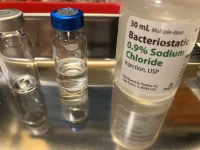
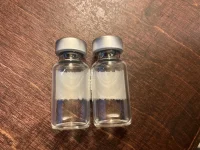
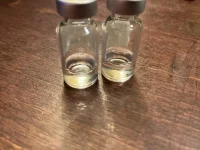
Here's why Retatrutide might salt out in 0.9% NaCl saline while Tirzepatide might not:
* Differences in Amino Acid Composition and Net Charge:
* Hydrophobicity/Hydrophilicity: Peptides are made of amino acids, which can be hydrophobic (water-fearing) or hydrophilic (water-loving). The overall balance of these residues significantly impacts solubility.
* Retatrutide (C221H342N46O68): Looking at its reported sequence and modifications, Retatrutide contains several modified amino acids (e.g., 2-aminoisobutyric acid (AiB), alpha-methyl leucine (MeL), and a large C20 diacid modification on a lysine). These modifications can introduce significant hydrophobic character. While it also has charged residues, the overall balance might lean towards being more susceptible to "salting out" when exposed to higher ionic strength. Some sources indicate Retatrutide needs pH adjustment (to pH 7 or 9) for good water solubility, suggesting it's sensitive to ionic conditions.
* Tirzepatide (C225H348N48O68): Tirzepatide also has a C20 fatty diacid moiety conjugated to a lysine residue. However, the specific placement and nature of this modification, combined with the overall amino acid sequence, might result in a more favorable balance of hydrophilic and hydrophobic interactions, or perhaps a different distribution of charged groups that makes it less prone to precipitation in saline. Tirzepatide is often described as being soluble in water and sparingly soluble in PBS (which is a buffered saline solution), suggesting it handles saline better than Retatrutide.
* Specific Chemical Modifications:
* Both peptides have fatty acid modifications (C20 diacid). These modifications are generally to extend the half-life by enabling albumin binding. However, the linker used to attach this fatty acid and its point of attachment on the peptide chain can critically influence the overall molecule's conformation and interaction with solvents.
* Small differences in these linkers or attachment points could expose different parts of the peptide to the solvent, making one more prone to aggregation or precipitation in a high-salt environment than the other.
* Isoelectric Point (pI):
* Every protein or peptide has an isoelectric point (pI), which is the pH at which its net electrical charge is zero. Proteins are generally least soluble at their pI because there are fewer repulsive forces between molecules to keep them apart, leading to aggregation and precipitation.
* It's possible that the pI of Retatrutide is closer to the pH of 0.9% NaCl saline (~5.5-6.5) than the pI of Tirzepatide. If Retatrutide's pI falls within this range, or if the ionic strength of saline pushes its effective pI closer to the solution's pH, it would be more susceptible to precipitation.
* Formulation Differences (Excipients):
* While you mentioned mixing your own, it's crucial to remember that commercially available lyophilized drug products often contain excipients (e.g., stabilizers, bulking agents, buffers) that are critical for maintaining solubility and stability upon reconstitution.
* Even if you obtained "raw" Retatrutide and Tirzepatide, their original pharmaceutical formulations (if they were designed to be commercial products) would have carefully selected excipients. It's possible that the commercial Retatrutide product might require specific excipients (which aren't present if you're using a generic powder) that help it stay in solution in saline, whereas Tirzepatide's inherent properties or the excipients in its typical formulation make it more robust in saline.
* Aggregation Propensity:
* Some peptide sequences have inherent tendencies to aggregate, especially in unfavorable conditions (like high ionic strength). This might be due to specific "hot spots" in their amino acid sequence that promote self-association. Retatrutide's structure might simply have a higher intrinsic propensity for aggregation in the presence of competing ions from saline.
In summary: The difference in "salting out" behavior between Retatrutide and Tirzepatide in saline likely boils down to subtle but critical differences in their:
* Specific amino acid sequence and overall balance of hydrophilic/hydrophobic residues.
* Nature and placement of chemical modifications (like the fatty acid chains and linkers).
* Isoelectric points (pI) relative to the pH of the diluent.
* Inherent conformational stability and propensity for aggregation in different ionic environments.
These factors determine how strongly the peptide molecules interact with water molecules versus with each other (or the salt ions), ultimately dictating their solubility. Always refer to the manufacturer's specific reconstitution instructions for any medication to ensure proper preparation and patient safety.