Anyone have remission of Obstructive Sleep Apnea with weight loss???

Status
Not open for further replies.
WLBLD said:
Has anyone also stopped snoring? After being on for a while or reaching goal?
I had mild sleep apnea when I was 150lbs overweight. I lost 125 and it's gone. No snoring, no apnea, no CPAP, I sleep like a baby now. The wife used to snore like a motorbike. I had ear plugs handy it was so bad. She's lost a similar percentage of weight as me and she almost never snores now... Thank you Jesus!
 
Lost 100 pounds on tirz and had a new sleep study. Zero apneas, zero snoring. OSA diagnosis officially resolved. Faithful CPAP (10 year old Resmed Airsense 10) into the dust bin of history. Hallelujah!

Edit: to clarify, my latest sleep study was a 4 day at home affair with sensors on the chest, stomach, oximeter on finger, and nasal cannula.
 
QueenMuntha said:
I ran an experiment with my Wellue O2 ring-wearing it continuously for the entire night-morning.
This is the answer you're looking for OP. A sleep study only captures one night under one set of conditions. It's useful for catching and setting up treatment for moderate to severe apnea (where your result is unambiguous). It's not great for evaluating borderline cases where a dozen random variables could affect your airways and may deviate between where the study is conducted VS your own bed VS a hotel bed.

Plus with your own ring you can evaluate if side sleeping might be necessary or if you can even get away with back sleeping without your machine and how the two positions might compare.

If you still suffer from mild OSA, you could also consider trying a dental appliance (either custom from your dentist or self-fit from a cheap Amazon kit) to see if that might be sufficient to resolve your OSA. There are some minor jaw issues that can come with that, but it's possible you could use the CPAP at home and take the dental appliance with you on trips (since it's much more portable), if it's sufficient to resolve your current degree of sleep apnea.

Lastly, there are some people who have perfected stomach sleeping positions and found their own custom stomach positions are sufficient to resolve their current degree of OSA. That's a little more complex than I care to explain here, but if you search a bit on OSA forums you'll likely find what I'm talking about described more thoroughly.

And, obviously, regardless of what the pulse oximeter says, how you feel the next morning is a critical variable too, but I wouldn't base my decision on how you feel alone, since one can often cope with mild sleep apnea and still be experiencing negative health effects from it without "feeling" it the next day.

 
latviantower said:
Lost 100 pounds on tirz and had a new sleep study. Zero apneas, zero snoring. OSA diagnosis officially resolved. Faithful CPAP (10 year old Resmed Airsense 10) into the dust bin of history. Hallelujah!

Edit: to clarify, my latest sleep study was a 4 day at home affair with sensors on the chest, stomach, oximeter on finger, and nasal cannula.
Dude! That is crazy - after 10 years you probably thought it would be for life. Nice.
 
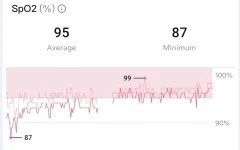
Technically Tirz cured my moderate OSA, but :

attachments-1777365371080-webp.21421.webp

First half is me falling asleep without putting the CPAP mask on, 2nd half is after waking up and putting it on.

The data is from a Ringconn Gen2, which is kind of a sleep apnea-focused ring.
 

Attachments

  • attachments-1777365371080-webp.21421.webp
    attachments-1777365371080-webp.21421.webp
    30.3 KB · Views: 0
tubby said:
This is the answer you're looking for OP. A sleep study only captures one night under one set of conditions. It's useful for catching and setting up treatment for moderate to severe apnea (where your result is unambiguous). It's not great for evaluating borderline cases where a dozen random variables could affect your airways and may deviate between where the study is conducted VS your own bed VS a hotel bed.

Plus with your own ring you can evaluate if side sleeping might be necessary or if you can even get away with back sleeping without your machine and how the two positions might compare.

If you still suffer from mild OSA, you could also consider trying a dental appliance (either custom from your dentist or self-fit from a cheap Amazon kit) to see if that might be sufficient to resolve your OSA. There are some minor jaw issues that can come with that, but it's possible you could use the CPAP at home and take the dental appliance with you on trips (since it's much more portable), if it's sufficient to resolve your current degree of sleep apnea.

Lastly, there are some people who have perfected stomach sleeping positions and found their own custom stomach positions are sufficient to resolve their current degree of OSA. That's a little more complex than I care to explain here, but if you search a bit on OSA forums you'll likely find what I'm talking about described more thoroughly.

And, obviously, regardless of what the pulse oximeter says, how you feel the next morning is a critical variable too, but I wouldn't base my decision on how you feel alone, since one can often cope with mild sleep apnea and still be experiencing negative health effects from it without "feeling" it the next day.
That is interesting, the bit about sleeping positions.

I have developed a odd sleeping position over years lying face down/left sided and slightly propped up with about 5 pillows, mainly so I would not wake up with a horribly sore dry throat from snoring. The logic was that that position would make my jaw fall forwards rather than back while sleeping and help with the snoring and the resultant sore throat. It sounds very like what you are describing, never occurred to me to look it up and see if it was something other people did. Probably makes it all the more likely I really did have sleep apnea, but now I have no snoring at all and my samsung watch says I do not have sleep apnea, probably not necessary to check it out now, unless I am stupid enough to put a lot of weight back on. Still sleep in that position out of habit mostly.
 
lessthanhalf said:
That is interesting, the bit about sleeping positions.

I have developed a odd sleeping position over years lying face down/left sided and slightly propped up with about 5 pillows, mainly so I would not wake up with a horribly sore dry throat from snoring. The logic was that that position would make my jaw fall forwards rather than back while sleeping and help with the snoring and the resultant sore throat. It sounds very like what you are describing, never occurred to me to look it up and see if it was something other people did. Probably makes it all the more likely I really did have sleep apnea, but now I have no snoring at all and my samsung watch says I do not have sleep apnea, probably not necessary to check it out now, unless I am stupid enough to put a lot of weight back on. Still sleep in that position out of habit mostly.
That's exactly the idea. I couldn't find the post I was talking about so I asked my chatbot buddy to hunt it down for me and it was successful:

https://www.cpaptalk.com/viewtopic.php?f=1&t=36738&start=15#p319598

I didn't put in the effort to test the position myself, but your thinking is pretty much what they were thinking too. And sleep apnea itself is very relative. Just as a snorer will get trained over time (by a pissed off partner) to sleep in a certain position, a mild OSA sufferer will figure out that they seem to sleep better in a certain position, causing it to become habit.

I know that I personally had to sleep on my side before getting a CPAP and really enjoyed being able to go back to being a back sleeper, which for me feels more comfortable, but doesn't lend itself to clear airways.

I'll also add that OSA is often an underappreciate concern in our space (fat people who aren't successful at getting and staying skinny). We all like to fixate on "calories," but good luck getting that to work if you're someone with severe untreated OSA who is getting a jolt of cortisol every minute of pseudo-sleep to enable you to start breathing again, getting up "to pee" every 20 minutes, and seeking whatever action you think might be able to help you sleep a little longer for that next stretch. Not impossible, but definitely adds a much greater difficulty level to maintaining such a behavior, not to mention the metabolic implications of the cortisol spikes. LOL
 
Status
Not open for further replies.

Trending content

Members online

No members online now.

Forum statistics

Threads
2,620
Messages
55,146
Members
1
Latest member
Admin
Back
Top