SS-31 protocols?

Status
Not open for further replies.
Fisherman2356 said:
I always doubt when people say I feel some more energy, and also when they say I heal faster. Those two are very subjective. As an example, I have more energy today than I had yesterday even though I never did anything. Long story short after trying almost every peptide there is I've come to the conclusion that at best it is money down the drain, and at worst it is money down the drain plus perhaps some unwanted side effect however small that may be.

So, I'm sorry to be blunt but no, you did not have more energy, or any positive effect from SS-31. GLP1's and HGH are an exception to the rest of peptide rule - being useless. BTW, I wish peptides really worked because I bought into the hype and still have one year or more worth stashed on a medical freezer with about 20-25 most common ones, I doubt I'll ever even use. This is my experience, and I think everyone who's getting great results it is getting a good dose of placebo effect.

I like what the behavioral economist

Rory Sutherland says about placebo effects. They should be welcomed as a way to maximize the overall effect.

In the Meso/steroid world, they have the opposite problem in a way. Many of the desired feelz are definitely steroid-related but so are the lab results saying your cholesterol, hematocrit, or PSA or ALT is up or heart imaging shows pathological thickening.

So effects of peptides like SS-31 may not show up in everyday lab results but they may be a form of insurance rather than liability, including for steroid users with supraphysiological levels of testosterone.

Some peptides like glutathione should help lower elevated values like ALT, based on what I remember in studies and anecdotal reports.

There is a way to test NAD levels in the blood but then the question is how much is getting to the cells. For Epithalon, one can do telomere testing. Soon it becomes a rich man's game, but some here could routinely afford such specialized testing.
 
I

Chuck11 said:
've been trying SS-31 for a clinically diagnosed mitochondrial disorder, linked to heterozygous PINK1 and OPA1 mutations. I've been taking large doses—15 to 30 mg per day for a week. It's hard to say if it's having a positive effect so far—maybe it would have been more effective if I'd started 15 years ago when the condition became full-blown. The goal is to upregulate mitochondrial fusion (defragmentation) via the working OPA1 copy.

I noticed that clinical trials use massive doses. Does anyone know why SS-31 is so expensive or if there's a way to get it cheaper? I probably need to buy a gram.

At this point, I'm planning to either get somewhat healthier or die trying—no joke. After a decade of promises, a Harvard-trained biomedical geneticist and mitochondrial expert told me there’s nothing in the drug pipeline—nothing panned out—so self-experimentation is my only option.
hope you are using red light therapy too! That’s a must for mitochondrial disorders . 660-940nanometer wavelength lights are so helpful. Probably more helpful than a lot of these peptides to be honest.
 
The large doses are for Barth’s disease. The trials were done at 40 mg/day subq. The 40 mg dose come from the pharmaceutical dose decided on for the treatment of Barths Syndrome:

Elamipretide, aka Ss-31 and its brand name is FORZINITY. It’s approved for use is Barth Syndome, a rare genetic disorder causing muscle weakness by targeting mitochondrial dysfunction, improving energy (ATP) production, reducing oxidative stress, and enhancing heart and muscle function in patients. This first-ever treatment for BTHS significantly improves physical activity and quality of life by stabilizing mitochondria, the cell's powerhouses, and is a major breakthrough for patients with this debilitating condition. “

The idea behind using 4 mg is just conjecture based on extrapolation from the legitimate dose used to treat a serious mitochondrial disease.
 
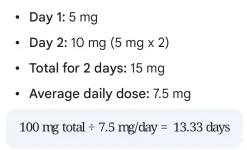
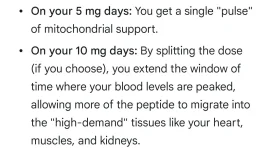
My current plan for SS-31 is 5 mg once a day alternating with twice a day. Total number of days would be 13 or 14 for my 10-mg kit:

attachments-screenshot_20251218_161656_google-webp.11746.webp


attachments-screenshot_20251218_163210_google-webp.11747.webp
 

Attachments

  • attachments-screenshot_20251218_161656_google-webp.11746.webp
    attachments-screenshot_20251218_161656_google-webp.11746.webp
    24 KB · Views: 1
  • attachments-screenshot_20251218_163210_google-webp.11747.webp
    attachments-screenshot_20251218_163210_google-webp.11747.webp
    52.8 KB · Views: 1
Crazy and criminal how much drug companies are charging for SS-31. Its name brand Forzinity (elamipretide) has a list price of $15,000/month!
 
Jellybelly54 said:
hope you are using red light therapy too! That’s a must for mitochondrial disorders . 660-940nanometer wavelength lights are so helpful. Probably more helpful than a lot of these peptides to be honest.
Evidence (i.e. studies, papers etc) please.
 
Fisherman2356 said:
Evidence (i.e. studies, papers etc) please.
An active clinical trial:

UK mitochondrial disease trials and research studies - The Lily Foundation

This study will test whether exposure to a specific frequency to red light improves muscle function and mobility in mitochondrial disease patients with fatigue.

www.thelilyfoundation.org.uk

quoted said:
Our work suggests that brief exposure to a specific frequency (670nm) of red light may improve mitochondrial function in mtDNA patients. But no robust studies have been done. We want to develop a way of testing whether 3-minute exposure to 670nm light improves muscle function and mobility in mtDNA patients with fatigue. We plan to use this test in a future trial showing whether 670nm light is an acceptable treatment and improves muscle function and mobility in mitochondrial patients. This may relieve symptoms, improve quality of life and save NHS costs.

Apparently, too much exposure can actually have an inverse effect. So one reason the exposure is only three minutes.
 
Fisherman2356 said:
Evidence (i.e. studies, papers etc) please.
I’m too lazy to provide links but a quick google search will provide a plethora. I will provide a link to a scholarly YouTube channel with a bunch of researchers presenting papers and stuff. Maybe it will “shed some light” . Pun intended😂

brain-PBM

The MGH Brain PBM Clinic is both a research and clinical team at Massachusetts General Hospital, striving to advance research and clinical care with the use of photobiomodulation (PBM). Photobiomodulation of the brain is a non-invasive modality of neuromodulation, using natural and safe...

youtube.com
 
Status
Not open for further replies.

Trending content

Members online

No members online now.

Forum statistics

Threads
2,789
Messages
59,468
Members
1
Latest member
Admin
Back
Top