Scientists remove “zombie” cells and reverse liver damage in mice

Status
Not open for further replies.

trojanpeptide

GLP-1 Enthusiast
Member Since
Nov 9, 2025
Posts
156
Likes Received
374
Location
saskatoon, canada
A cool article I read yesterday:

Scientists remove “zombie” cells and reverse liver damage in mice

A rogue set of “zombie” immune cells may be driving aging and fatty liver disease by flooding tissues with inflammation. Researchers found these cells accumulate with age and high cholesterol—and can make up most of the liver’s immune cells in older mice. When scientists removed them, liver...

www.sciencedaily.com

Says they treated some mice with navitoclax and that {i}n mice fed a high-fat, high-cholesterol diet, liver size dropped from about 7% of body weight to a healthier 4-5% percent. Body weight also fell by about 25%, decreasing from roughly 40 grams to around 30 grams .

I don't recommend anyone use navitoclax, but there are other senolytics.
 
trojanpeptide said:
A cool article I read yesterday:

Scientists remove “zombie” cells and reverse liver damage in mice

A rogue set of “zombie” immune cells may be driving aging and fatty liver disease by flooding tissues with inflammation. Researchers found these cells accumulate with age and high cholesterol—and can make up most of the liver’s immune cells in older mice. When scientists removed them, liver...

www.sciencedaily.com

Says they treated some mice with navitoclax and that {i}n mice fed a high-fat, high-cholesterol diet, liver size dropped from about 7% of body weight to a healthier 4-5% percent. Body weight also fell by about 25%, decreasing from roughly 40 grams to around 30 grams .

I don't recommend anyone use navitoclax, but there are other senolytics.
glp 's are doing similar on liver fat and inflammation already. Interesting article.
 
trojanpeptide said:
You're partially right; GLPs appear to be senomorphic, but are not true senolytics.
True, although I'm still trying to find out how current senolytics are superior to senomorphics. The current crop kills too many things, and most people are probably better off with senomorphics.
 
Habibibi said:
True, although I'm still trying to find out how current senolytics are superior to senomorphics. The current crop kills too many things, and most people are probably better off with senomorphics.
personally i would rather get rid of the problem than to mellow it out. In the linked study, they used senolytics, the mice improved. I don't think the outcome would have been the same using just quercetin, but maybe.

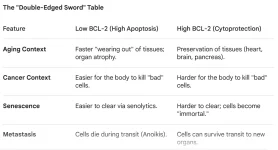
edit: after doing some more reading, I noted that GLP1-RAs increase the expression of BCL2 , which is a survival protein involved in preventing a cell from self destruction (ie. apoptosis). This is the opposite of senolysis, and would make it harder for a senolytic agent (such as D&Q) to function.

A little off topic, but given that several cancers take advantage of higher BCL2 expression, I was curious as to why they don't uptick cancers; it's been proposed that the overall anti-inflammatory effect of GLP1-RAs counteract BCL2's overexpression.

Here's a table AI produced

attachments-1776520119113-webp.20399.webp
 

Attachments

  • attachments-1776520119113-webp.20399.webp
    attachments-1776520119113-webp.20399.webp
    38.5 KB · Views: 1
trojanpeptide said:
personally i would rather get rid of the problem than to mellow it out. In the linked study, they used senolytics, the mice improved. I don't think the outcome would have been the same using just quercetin, but maybe.

edit: after doing some more reading, I noted that GLP1-RAs increase the expression of BCL2 , which is a survival protein involved in preventing a cell from self destruction (ie. apoptosis). This is the opposite of senolysis, and would make it harder for a senolytic agent (such as D&Q) to function.

A little off topic, but given that several cancers take advantage of higher BCL2 expression, I was curious as to why they don't uptick cancers; it's been proposed that the overall anti-inflammatory effect of GLP1-RAs counteract BCL2's overexpression.

Here's a table AI produced

View attachment 20399
That's assuming they only killed the "right" kind of cells. Also, the mice improved, but not clear if they would been better off on a senomorphic or not.
 
Habibibi said:
That's assuming they only killed the "right" kind of cells. Also, the mice improved, but not clear if they would been better off on a senomorphic or not.
yur right we can't tell with what we already know but i think there are prob benefits. We already see this in other studies as well.

attachments-1776561701954-webp.20445.webp


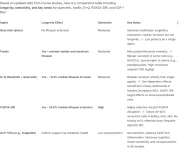
FOXO4-DRI has the highest selectivity , targeting only cells with active p53-FOXO4 complexes.

Fisetin is the most effective oral senolytic for lifespan extension.

D+Q shows sexually dimorphic outcomes —beneficial in males, harmful in females when given early.

Quercetin alone lacks longevity benefit despite healthspan improvements.

GLP-1 RAs act as senomorphics , suppressing SASP without clearing senescent cells.
 

Attachments

  • attachments-1776561701954-webp.20445.webp
    attachments-1776561701954-webp.20445.webp
    76.3 KB · Views: 1
trojanpeptide said:
yur right we can't tell with what we already know but i think there are prob benefits. We already see this in other studies as well.

View attachment 20445

FOXO4-DRI has the highest selectivity , targeting only cells with active p53-FOXO4 complexes.

Fisetin is the most effective oral senolytic for lifespan extension.

D+Q shows sexually dimorphic outcomes —beneficial in males, harmful in females when given early.

Quercetin alone lacks longevity benefit despite healthspan improvements.

GLP-1 RAs act as senomorphics , suppressing SASP without clearing senescent cells.
Have you tried FOXO4-DRI? I have been looking into trying it?
 
CNCCurrency said:
Have you tried FOXO4-DRI? I have been looking into trying it?
no man, i tried ordering some from our vendor friends and it got seized at the border. I spoke with someone earlier but they wanted too much for shipping. I've ordered some Dasatinib to try first anyhow.
 
trojanpeptide said:
Fisetin is the most effective oral senolytic for lifespan extension.
A great excuse to load up on strawberries too. I add them to my morning oats.

If you want to settle in for some good reading type Fisetin into PubMed.
 
trojanpeptide said:
personally i would rather get rid of the problem than to mellow it out. In the linked study, they used senolytics, the mice improved. I don't think the outcome would have been the same using just quercetin, but maybe.

edit: after doing some more reading, I noted that GLP1-RAs increase the expression of BCL2 , which is a survival protein involved in preventing a cell from self destruction (ie. apoptosis). This is the opposite of senolysis, and would make it harder for a senolytic agent (such as D&Q) to function.

A little off topic, but given that several cancers take advantage of higher BCL2 expression, I was curious as to why they don't uptick cancers; it's been proposed that the overall anti-inflammatory effect of GLP1-RAs counteract BCL2's overexpression.

Here's a table AI produced

View attachment 20399

The reason why bcl-2 family expression itself doesnt relate to cancer formation is because they are not true oncogenes. They do not promote cell division, angiogenesis, etc. They just favor cell survival which is not always a bad thing. However, in cells that have acquired oncogenic mutations, overexpression of bvl2 is definitely correlated with poorer outcomes.
 
Status
Not open for further replies.

Trending content

Members online

No members online now.

Forum statistics

Threads
2,620
Messages
55,146
Members
1
Latest member
Admin
Back
Top