丽塔需要经历高峰和低谷吗?

Status
Not open for further replies.
Calm Logic said:
Not enough for a small subset of endocrinologists, eh? I could understand why, but the theory never made much sense to me in the first place. If the theory was right, I think should have noticed something different with the second go. And how do you explain the dramatic weight gain with the SURMOUNT trial?

At least with the bro scientists, they seem to conflate chemical tolerance (as with caffeine or other stimulants) with metabolic signaling.
To be fair, it's possible that these doctors aren't actually that stupid. They could just be going along with the idea to humor their more stubborn patients. And then when a month off of a GLP fails to magically change the drug-induced plateau to some new lower number and the patient is pissed, it's probably just easier to spout some nonsense about 3 months off being necessary, hoping the patient won't call them on their bluff.
 
tubby said:
hoping the patient won't call them on their bluff.

Just when I started to like doctors again, haha.
 
r4000 said:
There are some physicians who believe receptor downregulation may be increased with split dosing--which is bad. i.e. the peaks and valleys of GLP-1 in blood serum are actually desirable. This youtube vid by Dr. Kevin Joseph goes into it:

View: https://youtu.be/FjyZSXPrbyk?t=236

I’m awfully skeptical of his claim that split dosing leads to receptor downregulation and a loss of clinical effect. It’s extremely speculative and not supported by actual trial data.

You know we had a split dosing study done for semaglutide, with daily dosing of all things. If split dosing lead to receptor downregulation and a loss of clinical effect we’d expect to see worse results than we do in weekly dose studies, but we don’t. They got the same sort of results you’d expect to see with semaglutide weekly. Check it out yourself: https://gwern.net/doc/longevity/glp/semaglutide/2018-oneil.pdf
 
GusGustavson said:
the fact that the daily semaglutide pill works pretty good should be pretty good proof that the up and down are not needed (the studies showed very consistend blood levels with the daily pill)
Your logic is completely flawed. Different drugs, different mechanisms, different binders.
 
zpped said:
Your logic is completely flawed. Different drugs, different mechanisms, different binders.
okay. i must have misread all those studies.
 
GusGustavson said:
okay. i must have misread all those studies.
What study did you read that compared retatrutide to Rybelsus
 
Calm Logic said:
The peaks and valleys with weekly dosing didn't stop me from losing weight, but I don't think they are necessary.

Bingo, this is a very long cruise (in bro speak), like those people who retire on a cruise ship. We will not be visiting the ports.

The reset your receptors thing is mostly BS, as far as I can tell. I took a month off tirz (for a break from sides), and that didn't help at all for resuming tirz more effectively.
good to know. There have been people who reported doing that and jumping right back in at previous dose and ending up in ER. You never know for sure how your body will respond.
 
SpaceJumper said:
Wondering how maximizing compliance maximizes revenue? May be a little slow on the uptake over here.

Thanks for the perspective.
If they quit using it. They dont pay anymore... Or if they use less because they dont want to poke themselves they pay less. Compared to people who comply, see results, continue buying as long as they can. The higher the dose, the more the co can charge per dose...thus the push to titrate up on a fast schedule
 
micro dosing(daily shots) will give you the side effects without the benefits.. its designed to be given at a larger dose and hit the receptors hard than tapering off. The scientists designed specifically to take one shot a week for multiple reasons other than just convenience. This doc explains the mechanisms.

View: https://www.youtube.com/watch?v=WyUgRv8oRik&t=1978s
 
desinr-gal said:
good to know. There have been people who reported doing that and jumping right back in at previous dose and ending up in ER. You never know for sure how your body will respond.
i took 6 six weeks off reta and my sensitivity went way up.. had to reduce my dose of where i left off once i came back on.. even without feeling hunger suppression this peptide is doing all kinds of beneficial things and giving you a biological reset to your energy systems ..
 
ironbull said:
micro dosing(daily shots) will give you the side effects without the benefits.. its designed to be given at a larger dose and hit the receptors hard than tapering off. The scientists designed specifically to take one shot a week for multiple reasons other than just convenience. This doc explains the mechanisms.

View: https://www.youtube.com/watch?v=WyUgRv8oRik&t=1978s

He says microdosing is dumb, you don’t know better than the people who designed it… then he says start at .25-.5mg weekly, the sweet spot is 4mg.
 
SVT810E said:
I’m awfully skeptical of his claim that split dosing leads to receptor downregulation and a loss of clinical effect. It’s extremely speculative and not supported by actual trial data.

You know we had a split dosing study done for semaglutide, with daily dosing of all things. If split dosing lead to receptor downregulation and a loss of clinical effect we’d expect to see worse results than we do in weekly dose studies, but we don’t. They got the same sort of results you’d expect to see with semaglutide weekly. Check it out yourself: https://gwern.net/doc/longevity/glp/semaglutide/2018-oneil.pdf
Thanks for that link . I was not aware this study had been done so I will be reading it.

This relates to the comments by Ironbull.

Unfortunately the fact that someone has a medical degree, does not automatically mean that their views are supported by scientific evidence. The louder, more controversial or even more popular they are the more likely they are to be talking BS. This seems to be especially the case in the US where celebrity / influencers often have strong financial motives to support particular products or simply to provide controversy to increase engagement with their posts/videos, and there seem to rarely be any professional consequences for Doctors using these systems to promote unscientific viewpoints. I personally am grateful that this is less of an issue in Australia, where doctors can face professional consequences for supporting unproven or potentially dangerous therapies for personal gain or otherwise.

There is nothing in the pharmacology of these receptors or drugs that indicates that peaks and dips are needed for effects, it just does not make sense on a mechanistic level. Yes weekly dosing was chosen partly for convenience, but this makes sense, making it easier for patients to remember their dose is a good idea , it increases compliance by requiring less frequent injections and without complex reminder systems to remember 5th or 6th daily dosing which I know from experience is much easier to mess up. And increased compliance makes the drugs work better in real life, which is the point, rather than being aimed at maximising compliance for maximising profit.

Most drugs for long term administration have more stable blood levels than weekly glp's, usually being dosed more often than the half life, as generally most drugs benefit by having consistent levels and consistent effects. For me I prefer more frequent use than weekly to reduce side effects for a given weekly dose. I was able to tolerate 0.8mg of semaglutide a week by second daily dosing of 0.22mg , but was unable to tolerate a weekly dose of 0.55mg, any higher than either of these doses caused very unpleasant nausea, and 0.2mg/2days provided improved hunger control than 0.5mg/week.

Given the research was done , it make sense to follow their guidelines, as there is information about what to expect. If there are no problems and it works there are no sensible reasons to change it. More frequent smaller doses are entirely aimed at reducing peak blood level side effects for a given dose, you could use it if effects wore off after 5 or 6 days or you could just increase the weekly dose in that case. The vast majority of experience from frequent smaller doses is online and not in studies, it is unfortunately not very reliable evidence , but nothing I have seen suggests there is any difference in the effects on weight if it is used weekly or more often for a given weekly dose.

 
SVT810E said:
I’m awfully skeptical of his claim that split dosing leads to receptor downregulation and a loss of clinical effect. It’s extremely speculative and not supported by actual trial data.

You know we had a split dosing study done for semaglutide, with daily dosing of all things. If split dosing lead to receptor downregulation and a loss of clinical effect we’d expect to see worse results than we do in weekly dose studies, but we don’t. They got the same sort of results you’d expect to see with semaglutide weekly. Check it out yourself: https://gwern.net/doc/longevity/glp/semaglutide/2018-oneil.pdf
Weekly dosing will have a higher steady state concentration than split dosing.
 
But area under the curve will be the same or close to it, for a given weekly dose, and that is generally what correlates best with any drug effect or any adaptive effect on receptors.
 
MFGamesta said:
Weekly dosing will have a higher steady state concentration than split dosing.

Does that matter?

Does it change the fact that a 52 week daily dosing study produced results comparable to what we see in weekly dosing studies?

attachments-img_1126-webp.16840.webp

I understand that people can come up with all sorts of ad hoc justifications for why weekly dosing or split dosing is the one true solution. But the reality is much more boring: it doesn’t really seem to matter.
 

Attachments

  • attachments-img_1126-webp.16840.webp
    attachments-img_1126-webp.16840.webp
    93.7 KB · Views: 1
SVT810E said:
Does that matter?

Does it change the fact that a 52 week daily dosing study produced results comparable to what we see in weekly dosing studies?

I understand that people can come up with all sorts of ad hoc justifications for why weekly dosing or split dosing is the one true solution. But the reality is much more boring: it doesn’t really seem to matter.

I think that weekly dosing is probably more about patient satisfaction and compliance, than overall efficacy. But even still, I find the results of this study interesting.

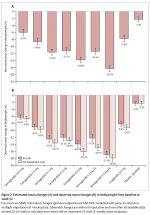
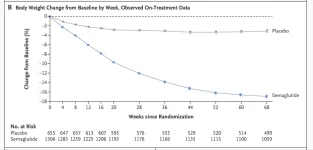
The study you mentioned had daily dosing as compared to the STEP-1 which was weekly dosing. The on treatment mean weight loss at week 52 in the daily dosing regime is greater than the weekly dosing. Although STEP-1 doesn’t report the actual % at week 52, it seems like it’s around 16%, compared to 18% on the daily dose. To your point, both effective, and does the 2% difference between the two really matter? For my starting weight , the difference between daily versus weekly would be 7 lbs.

attachments-1772536992366-webp.16846.webp
 

Attachments

  • attachments-1772536992366-webp.16846.webp
    attachments-1772536992366-webp.16846.webp
    33 KB · Views: 2
Grogu said:
I think that weekly dosing is probably more about patient satisfaction and compliance, than overall efficacy. But even still, I find the results of this study interesting.

The study you mentioned had daily dosing as compared to the STEP-1 which was weekly dosing. The on treatment mean weight loss at week 52 in the daily dosing regime is greater than the weekly dosing. Although STEP-1 doesn’t report the actual % at week 52, it seems like it’s around 16%, compared to 18% on the daily dose. To your point, both effective, and does the 2% difference between the two really matter? For my starting weight , the difference between daily versus weekly would be 7 lbs.

View attachment 16846
I’m not trying to overstate the case. The 18% result is a pretty good result for a semaglutide trial, but it’s not a perfect apples to apples comparison. 0.4mg/day is 2.8mg/week which is a slightly higher dose than normal. It’s also in a fast escalation treatment group where they increased their dose every two weeks. In a normal escalation group where they increased monthly the same final dose got us 16.2% (which is also a good result). There’s also normally quite a bit of variation in trial results. For example in the Surmount-1 trial (tirzepatide obesity phase 3) we saw 22.5% average weight loss for people who followed the 15mg titration. The more recent Redefine-4 trial (cagrisema vs tirzepatide) trial had a 25.5% average result for people who adhered to the 15mg titration. Both of those results are true and they illustrate how different trials of the same thing will often get slightly different results.

The results for daily semaglutide are strong enough to say that it’s very much on the same level as weekly semaglutide, but they’re in the ballpark of what we’d expect to see in a weekly semaglutide trial.
 
SVT810E said:
Does that matter?

Does it change the fact that a 52 week daily dosing study produced results comparable to what we see in weekly dosing studies?
This thread is about Retatrutide. That study is about Semaglutide.

Glucagon agonist is key difference.
 
zpped said:
This thread is about Retatrutide. That study is about Semaglutide.

Glucagon agonist is key difference.
Of course, they are different drugs.

Have you seen any studies showing that daily retatrutide produces inferior results to weekly retatrutide? What are we basing the idea that daily dosing would produce inferior clinical effect on?
 
lessthanhalf said:
而且,提高依从性可以让药物在现实生活中发挥更好的作用,这才是关键所在,而不是为了最大化利润而追求最大化依从性。

举个简单的例子:假设一种新药有两种不同的给药方式。一种方式能将患者的生活质量提高30%,但会使制药公司的收入减少5%。另一种方式是“标准”给药方式,虽然无法提高患者的生活质量,但可以维持收入。

作为一名医生,我知道你会选择能提高患者生活质量的给药方式,制药公司也明白这一点。考虑到这一点,你认为制药公司的高管会帮助医生了解这种替代给药方式吗?还是他们会避免宣传这类信息,甚至可能主动压制?我并不是说GLP(良好实验室规范)就是这样,只是想听听你对这个例子的看法,因为你似乎认为驱动这些大型跨国公司的目标并非仅仅是利润最大化。
 
Status
Not open for further replies.

Members online

No members online now.

Forum statistics

Threads
4,434
Messages
86,405
Members
7,877
Latest member
jhonpdr
Back
Top