I think the biggest conceptual challenge is probably understanding that reta is fundamentally different from sema. Both act as GLP-1 agonists (which often is described as suppressing appetite). With sema the playbook seems to be to view obesity as nothing more than an excess calorie problem with the solution being to restrict calories. There is a slight hormonal enhancement there as well, but the lion's share of the work is being done by the reduced food intake.
With reta, that effect is still present (for better or worse), but the glucagon suppression is an entirely different and independent effect that's harder to explain and perhaps not well understood. It's unfortunate that there isn't a well-studied peptide that acts only as a glucagon receptor agonist (so that this effect could be better isolated and experienced).
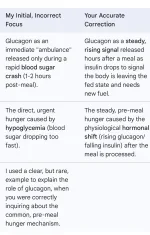
I might be able to offer some insight from the low-carb world (in the context of someone not taking any weight loss meds): Typically when a person eats a mixed diet (that includes high-glycemic carbs), they'll get regular hunger pings before meals. When someone goes low-carb or keto they'll often note that the volume of those pings gets turned way down, to the point where if they're wrapped up in a task they might simply forget to eat. I would wager that one of the factors at play here is a both lower and stable glucagon level on low-carb and suspect that as glucagon creeps back up (when not on low-carb), that's one of the hunger triggers. To the extent reta keeps glucagon from creeping back up at those points, it should to some degree simulate the appetite suppression effects associated with low-carb diets. Just guessing here, of course.
With reta, that effect is still present (for better or worse), but the glucagon suppression is an entirely different and independent effect that's harder to explain and perhaps not well understood. It's unfortunate that there isn't a well-studied peptide that acts only as a glucagon receptor agonist (so that this effect could be better isolated and experienced).
I might be able to offer some insight from the low-carb world (in the context of someone not taking any weight loss meds): Typically when a person eats a mixed diet (that includes high-glycemic carbs), they'll get regular hunger pings before meals. When someone goes low-carb or keto they'll often note that the volume of those pings gets turned way down, to the point where if they're wrapped up in a task they might simply forget to eat. I would wager that one of the factors at play here is a both lower and stable glucagon level on low-carb and suspect that as glucagon creeps back up (when not on low-carb), that's one of the hunger triggers. To the extent reta keeps glucagon from creeping back up at those points, it should to some degree simulate the appetite suppression effects associated with low-carb diets. Just guessing here, of course.