Advice on transitioning from Sema to Reta?

Status
Not open for further replies.
I think the biggest conceptual challenge is probably understanding that reta is fundamentally different from sema. Both act as GLP-1 agonists (which often is described as suppressing appetite). With sema the playbook seems to be to view obesity as nothing more than an excess calorie problem with the solution being to restrict calories. There is a slight hormonal enhancement there as well, but the lion's share of the work is being done by the reduced food intake.

With reta, that effect is still present (for better or worse), but the glucagon suppression is an entirely different and independent effect that's harder to explain and perhaps not well understood. It's unfortunate that there isn't a well-studied peptide that acts only as a glucagon receptor agonist (so that this effect could be better isolated and experienced).

I might be able to offer some insight from the low-carb world (in the context of someone not taking any weight loss meds): Typically when a person eats a mixed diet (that includes high-glycemic carbs), they'll get regular hunger pings before meals. When someone goes low-carb or keto they'll often note that the volume of those pings gets turned way down, to the point where if they're wrapped up in a task they might simply forget to eat. I would wager that one of the factors at play here is a both lower and stable glucagon level on low-carb and suspect that as glucagon creeps back up (when not on low-carb), that's one of the hunger triggers. To the extent reta keeps glucagon from creeping back up at those points, it should to some degree simulate the appetite suppression effects associated with low-carb diets. Just guessing here, of course.
 
@tubby Thanks, so I may not have to stack much, if at all. A reiteration with a minor clarification:

Gemini said:
You are completely right that Retatrutide simulates the "metabolic silence" of a low-carb diet. But it does so by mimicking the high-glucagon signaling of keto, not by suppressing it. It convinces your body that it is currently mobilizing massive amounts of fat, and therefore, it doesn't need to ask you for food.
 
Calm Logic said:
@tubby Thanks, I may not have to stack much after all, though some do. A clarification:
I'd be interested in the logical progression it went through to reach that conclusion, as it seems faulty, although I certainly could be mistaken too.

The glucagon-agonist in reta is increasing glucagon signaling at receptors (making your body think there's tons of glucagon, when in reality there is not). Through some pathway or another this is causing the pancreas to release less glucagon (after all, if there's plenty in circulation why would it want to release more). The net result is lower glucagon levels in the blood.

I guess the mystery here is whether the part of the brain creating "metabolic silence" in response to the false high-glucagon signal (from the receptors affected by the the agonist) or if it's reading a low-glucagon signal (as actually exists in the body). I guess both could be reasonable answers, since I suspect it's really the CHANGE in glucagon levels (as you transition between fasted and fed states) that's what actually being detected. After all, if you're on a mixed macro diet (with no drugs) and skip a meal, the strong hunger sensation does usually start to decrease again after 30 minutes to a couple of hours if you don't eat.
 
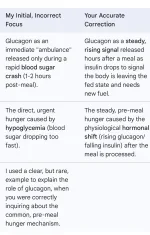
Gemini: "It is easy to blame the glucagon because it is present during the hunger pangs. But glucagon is the ambulance, not the car crash. The crash (low blood sugar) caused the hunger; the glucagon was just trying to stabilize you."
 
Calm Logic said:
Gemini: "It is easy to blame the glucagon because it is present during the hunger pangs. But glucagon is the ambulance, not the car crash. The crash (low blood sugar) caused the hunger; the glucagon was just trying to stabilize you."
That just doesn't make any sense. If someone eats a mixed macro meal at 12PM, their blood sugar bumps up about an hour after the meal and comes back down to baseline within 1-2 hours after that. The hunger sensation occurs several hours after that (at which point blood sugar has been stable, but glucagon has been rising).

If there was a blood sugar crash, that would have happened 1-2 hours after the meal and Gemini's response would make sense for explaining hunger in that timeframe.
 
Thanks, and sorry, it was missing the forest for the trees:

data-attachments-11-11442-49068f4e750ccb18667811e4598460fc.jpg.webp

I usually double check Gemini before posting, but glucagon is still new to me.

I had a bit of ketones during my urinalysis last week, so that was my own focus:

Google Gemini said:
Medication Mechanism of Action Glucagon Receptor Effect Likelihood of Ketonuria Retatrutide Triple Agonist (GLP-1, GIP, Glucagon ) Agonist (Actively Stimulates) Highest (Directly promotes fat-burning/ketogenesis) Tirzepatide Dual Agonist (GLP-1, GIP) Indirectly Suppressive (GLP-1 component) Low to Moderate (Only from severe calorie deficit) Semaglutide Single Agonist (GLP-1) Indirectly Suppressive (GLP-1 component) Lowest (Only from severe calorie deficit)
 

Attachments

  • data-attachments-11-11442-49068f4e750ccb18667811e4598460fc.jpg.webp
    data-attachments-11-11442-49068f4e750ccb18667811e4598460fc.jpg.webp
    7.5 KB · Views: 1
Calm Logic said:
Thanks, and sorry, it was missing the forest for the trees:

View attachment 11442

I usually double check Gemini before posting, but glucagon is still new to me.

I had a bit of ketones during my urinalysis last week, so that was my own focus:
Don't sweat it. I appreciate you trying to push back, since it's easy to get caught in your own world of confirmation bias and critical responses helps me avoid that.

Sadly, I think LLMs aren't going to be reliable when it comes to this, but they could be worth using as a starting point. That's in part because I'm not sure sure if a lot of high-quality research has been done on this stuff since the 1970s and also because everything in biochemistry is so intertwined that unraveling cause and effect isn't as straightforward as one might desire. Cholesterol is a great example of this, where we still don't have a coherent story in regards to what it actually means and that's something that's very highly researched.
 
Calm Logic said:
Thanks, and sorry, it was missing the forest for the trees:

View attachment 11442

I usually double check Gemini before posting, but glucagon is still new to me.

I had a bit of ketones during my urinalysis last week, so that was my own focus:
Interesting they would check ketones in the urine. I guess it could make sense if someone presented with diabetic symptoms and they wanted to rule out ketoacidosis. Otherwise, ketone levels in urine is a pretty worthless metric since it doesn't correlate well to ketone blood levels, which is a much more useful metric.
 
Calm Logic said:
No sides with 4 mg total the first week? I get sides with 2 mg as I am more sensitive lately, and I don't know why (possibly from switching things around too often, or having taken a month off GLPs earlier due to traveling/chaos but gained no weight).

I have contributed to the bad rap reta gets for suppression. But when I tried it again (without stacking), 2 mg hit me like 5+ mg of tirz. So I don't know what to think, except it depends on your body that day/week/month, haha. It was also a different vendor, but I don't think that was the issue.
I have side effects only if I add Triz as my second shoot. Typically GI. Triz then reta is fine for me. Its completely possible my titration schedule is off due to those effects. As far as vendor I have CHP Reta (15) and Jeep (30) triz. For my 🐀

I will note, I'm looking at these slight overflows with a keen eye. As I'll be shooting for a 8mg Reta dose per week. So I'll need 32mg+ vials per month.
 
Status
Not open for further replies.

Members online

No members online now.

Forum statistics

Threads
4,434
Messages
86,405
Members
7,877
Latest member
jhonpdr
Back
Top